插
Character Story & Explanation
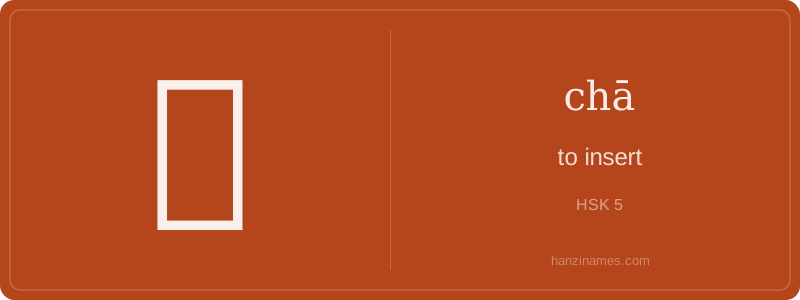
插 is widely used in modern Chinese for both literal and figurative insertion: plugging in devices (插电源 chā diànyuán), joining queues (插队 chāduì), or adding content (插图 chātú — 'illustration'). It appears in the common idiom 插翅难飞 (chā chì nán fēi, 'even with wings, hard to fly'—meaning 'inescapable'), documented since at least the Ming dynasty in vernacular fiction. The phrase underscores how 插 modifies nouns to imply *added capability*, not just physical placement.
The character’s form combines 扌 (hand radical) and 乏 (fá, originally meaning 'exhaustion', here serving phonetically). Though not a pictograph, its structure reflects hand action. Historically, 插 first appeared in clerical script (Lìshū) during the Han dynasty, evolving from earlier forms where the right component indicated sound. No oracle bone or bronze inscriptions contain 插—it emerged later as a functional compound for manual insertion tasks.
The Chinese character 插 (chā) conveys the core action of inserting, thrusting, or interjecting something into a space—physically or abstractly. Unlike English verbs that often specify direction or object (e.g., 'plug in', 'slide in', 'interject'), 插 is remarkably versatile: it applies to sticking a chopstick into rice, inserting a USB drive, cutting in line, or even inserting a comment mid-conversation. Its semantic breadth reflects the Chinese linguistic tendency to prioritize action essence over grammatical nuance.
Western equivalents vary by context: 'insert' (technical), 'jam' (forceful), 'cut in' (social), or 'interpose' (formal). Yet none fully capture 插’s neutral-to-assertive spectrum. In English, inserting a needle implies precision; jamming a key suggests urgency. 插 sits comfortably between them—neither clinical nor aggressive—making it culturally adaptable across domains from acupuncture to software development.
This flexibility mirrors broader East Asian values of contextual appropriateness and functional harmony. Where Western metaphors often emphasize control ('plug', 'install') or disruption ('butt in'), 插 carries pragmatic neutrality—its tone shaped entirely by context, measure words, and accompanying verbs. That adaptability explains why it appears in HSK 5: learners must grasp not just meaning, but *how* 插 negotiates intention, force, and social register in real usage.
Example Sentences
Common Compounds
Similar Characters — Don't Mix These Up
Your First Step into Chinese Culture: Get a Chinese Name
Every journey into Chinese begins with a name. Use our free Chinese name generator to create a meaningful, personalized Chinese name that fits you perfectly.
Get My Chinese Name →