握
Character Story & Explanation
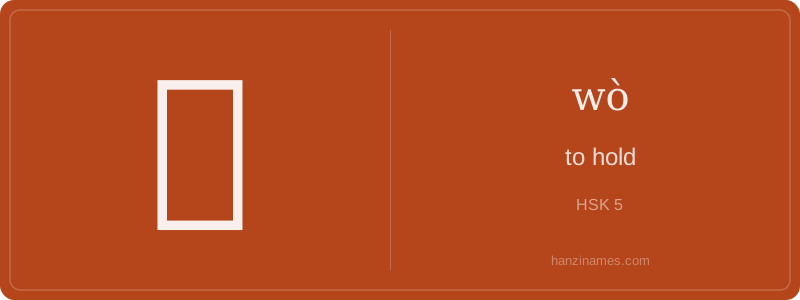
握 is central to Chinese social etiquette: 握手 (wò shǒu) has been the standard formal greeting since the early 20th century, replacing traditional bows in diplomatic and business settings. It appears in idioms like 握手言和 (wò shǒu yán hé, 'shake hands and make peace'), documented in modern political discourse since the 1950s. In daily life, it’s used in instructions (e.g., '请握紧扶手' — 'Please hold the handrail tightly') and safety signage across subways and elevators nationwide.
The character is not pictographic; its earliest attested form appears in seal script (c. 3rd century BCE), where 扌 + 屋 already functioned as a semantic-phonetic compound. While 屋 originally meant 'roof', here it serves only as a sound clue — no historical link to buildings. Today, Chinese learners practice 握 while learning stroke order: the hand radical first, then the six-stroke 屋 component — a rhythm that mirrors the deliberate motion of grasping.
Hi students! Let’s learn 握 (wò), a Level 5 HSK character meaning 'to hold' or 'to grasp' — like gripping a pen, shaking hands, or clutching a key. It’s an action verb that always involves physical contact with the hand. Notice its radical 扌 (hand radical) on the left — this tells us immediately it’s related to hand movement. The right side, 屋 (wū), is a phonetic component that hints at pronunciation but doesn’t carry meaning here.
This character is very common in both spoken and written Chinese. You’ll hear it in everyday phrases like 握手 (wò shǒu, 'to shake hands') — a universal gesture of greeting or agreement. Unlike English ‘hold’, 握 implies active, intentional gripping, not passive holding (e.g., you 握 a sword, but you 拿 a book). That nuance matters for natural usage!
As a beginner, focus on using 握 with concrete nouns: 握刀 (wò dāo, 'to grip a knife'), 握笔 (wò bǐ, 'to hold a pen'). Avoid abstract uses unless you’re copying set phrases — native speakers rarely say *'握机会' (grasp opportunity); instead, they use 抓住机会 (zhuā zhù jī huì). Accuracy builds confidence — and 握 is a great verb to master early for real-world interaction.
Example Sentences
Common Compounds
Similar Characters — Don't Mix These Up
Your First Step into Chinese Culture: Get a Chinese Name
Every journey into Chinese begins with a name. Use our free Chinese name generator to create a meaningful, personalized Chinese name that fits you perfectly.
Get My Chinese Name →