挥
Character Story & Explanation
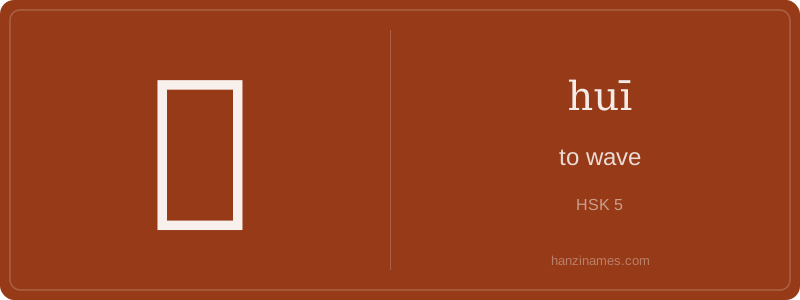
In daily life, 挥 is ubiquitous in both concrete and figurative contexts: commuters 挥手 (huīshǒu) to hail taxis, conductors 挥棒 (huī bàng) to lead orchestras, and leaders 挥毫 (huīháo) when writing calligraphy—a phrase famously used of Mao Zedong and other statesmen. It appears in the idiom 挥洒自如 (huīsǎ zìrú, ‘to handle freely and effortlessly’), rooted in ink-painting tradition where mastery is shown through confident, flowing brushstrokes.
The character’s form is not pictographic but phonosemantic: 扌 (hand radical) + 辉 (phonetic, huī). While 辉 itself derives from ‘light’ (光 + 哗, suggesting brilliance), its use here is primarily sound-based. No verified oracle-bone form exists—its earliest confirmed appearance is in Han-era clerical script inscriptions, where it already carried the meaning ‘to wave’ or ‘to wield’.
As a linguistic detective, I begin at the scene: the modern character 挥 (huī). Its left-hand radical 扌—'hand'—immediately signals bodily action. The right component, 辉 (huī), originally meant 'radiance' or 'brilliance' (as in 光辉, guānghuī, 'glory'), but here it serves phonetically, lending the pronunciation while subtly evoking vivid, sweeping motion—like light arcing through air. This phonosemantic structure is classic for HSK-5 characters: form guides meaning, sound anchors memory.
Zooming in on stroke order: nine precise movements tell a story of controlled energy—starting with the vertical stroke of 扌, then three connected motions across the top of 辉, culminating in the decisive downward sweep of the final dot-stroke (丶). Each stroke mirrors real-world gesture: the wrist’s pivot, the arm’s extension, the release. No stroke is ornamental; all serve biomechanical plausibility—exactly how native writers internalize ‘waving’ as both verb and embodied habit.
Historically, 挥 appears reliably from the Tang dynasty onward in texts describing military commands (挥旗, ‘wave the flag’) and poetic gestures (挥毫, ‘wield the brush’). Unlike archaic pictographs, it shows no oracle-bone or bronze-script ancestry—it’s a mature, standardized character born of clerical script refinement. Its semantic range expanded pragmatically: from literal waving to metaphorical ‘dispersal’ (挥霍, ‘squander’) and ‘execution’ (挥动, ‘swing into action’)—revealing how Chinese extends physical verbs into abstract domains through consistent, logical metaphor.
Example Sentences
Common Compounds
Similar Characters — Don't Mix These Up
Your First Step into Chinese Culture: Get a Chinese Name
Every journey into Chinese begins with a name. Use our free Chinese name generator to create a meaningful, personalized Chinese name that fits you perfectly.
Get My Chinese Name →