构
Character Story & Explanation
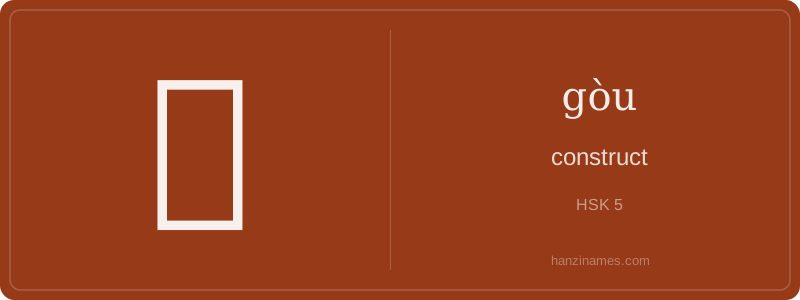
In everyday Chinese life, 构 appears frequently in formal signage, policy documents, and academic writing—not in casual speech. You’ll see it on construction site banners (如:构建和谐社会 — 'building a harmonious society'), university syllabi (‘课程结构’), and news headlines about economic reform ('产业结构调整'). It’s absent from spoken phrases like '够了!' (‘Enough!’) — that’s always 够. The idiom ‘构不成威胁’ (‘does not constitute a threat’) is a standard legal and diplomatic phrase documented in official Xinhua News Agency reports since the 1980s.
Graphically, 构 is a phono-semantic compound: 木 (radical, indicating wood/building-related meaning) + 勾 (phonetic, gōu → gòu). First attested in Song-era printed texts as a variant for 夠, it gradually specialized in structural meanings by the Ming-Qing period. Today, its written form is standardized under GB2312 and used consistently in mainland China’s education system and official publications.
The character 构 (gòu) is a simplified form of the traditional 夠, both meaning 'enough' or 'sufficient'. Though officially listed in some dictionaries as a variant, in modern Standard Mandarin, 构 is almost never used for 'enough'—that role belongs exclusively to 够. This distinction is critical: using 构 to mean 'enough' would confuse native speakers and is considered incorrect in contemporary usage.
Instead, 构 functions primarily as a verb meaning 'to construct', 'to form', or 'to constitute', especially in formal, technical, or academic contexts. Its radical 木 (wood) reflects its original association with building—like timber framing—and its phonetic component 勾 (gōu) hints at shaping or outlining. This semantic shift from physical construction to abstract structuring (e.g., 构建 theory) is central to its modern utility.
HSK Level 5 places 构 at an intermediate-advanced threshold because learners must distinguish it from homophones like 够 and grasp its collocational patterns—especially in compounds like 构成 (constitute), 构造 (structure), and 构建 (build/establish). Misusing it as a synonym for 够 remains one of the most common errors among non-native speakers, making precise contextual awareness essential.
Example Sentences
Common Compounds
Similar Characters — Don't Mix These Up
Your First Step into Chinese Culture: Get a Chinese Name
Every journey into Chinese begins with a name. Use our free Chinese name generator to create a meaningful, personalized Chinese name that fits you perfectly.
Get My Chinese Name →