个
Character Story & Explanation
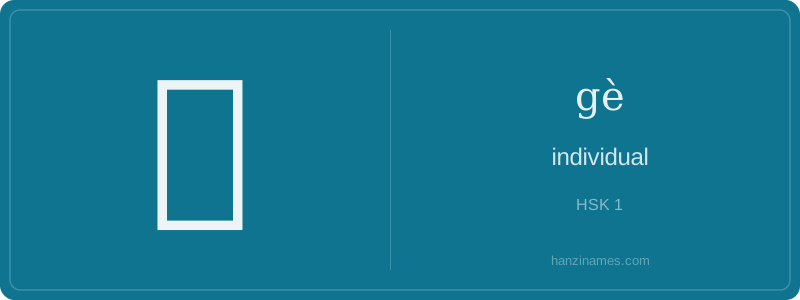
个 is the most frequently used measure word in Mandarin—appearing over 100 million times annually in Chinese media and daily speech. It serves as the default classifier for nouns lacking a specific one (e.g., 一个人, 一个想法). Historically, it appears in early medieval texts like the Tang dynasty’s Yunhai jingyuan (c. 780 CE) as a general counter, and remains central in modern HSK-1 vocabulary. Common phrases include 个人 (gèrén, 'individual/person') and 每个人 (měi gè rén, 'everyone').
The character’s earliest attested form appears in clerical script (lìshū) during the Han dynasty—not as a pictograph, but as a simplified derivative of the ancient character 個, originally composed of 人 (person) and 固 (to fix/secure). Over centuries, the left-side 人 was dropped and the right side reduced to 丨+一+丶, yielding today’s streamlined 个—a testament to Chinese writing’s evolution toward functional efficiency.
The character 个 (gè) is deceptively simple—just three strokes—but it opens a profound window into the Chinese worldview: valuing the individual not as isolated, but as an essential, relational unit within a whole. Unlike Western notions that often contrast 'individual' with 'collective' as opposites, Chinese thought sees the 个 as the irreducible, concrete node through which relationships, roles, and meaning are anchored—whether a person, an object, or even an abstract concept like 'a moment' or 'a reason'.
This reflects Confucian-influenced humanism: every 个 carries inherent dignity and responsibility—not by virtue of autonomy alone, but through its situatedness in family, society, and moral order. The character appears everywhere—from counting apples to naming social roles ('a teacher', 'a friend')—signaling that identity is always embodied, countable, and contextually meaningful, never purely abstract or disembodied.
Even grammatically, 个 functions as a universal classifier when no specific one applies—revealing a linguistic humility toward precision. Rather than forcing rigid categorization, Chinese allows flexibility: if you don’t know the exact classifier for something unfamiliar, 个 stands in gracefully. This mirrors a cultural comfort with provisional understanding and relational pragmatism—knowing that meaning emerges not from fixed labels, but from use, context, and care.
Example Sentences
Common Compounds
Similar Characters — Don't Mix These Up
Your First Step into Chinese Culture: Get a Chinese Name
Every journey into Chinese begins with a name. Use our free Chinese name generator to create a meaningful, personalized Chinese name that fits you perfectly.
Get My Chinese Name →