国
Character Story & Explanation
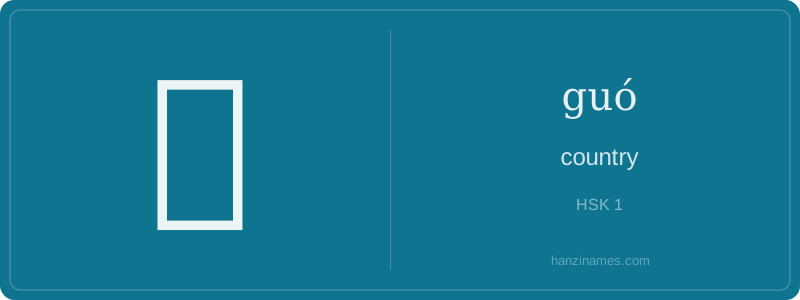
国 is ubiquitous in modern Chinese: it appears in official terms like 中华人民共和国 (Zhōnghuá Rénmín Gònghéguó, People’s Republic of China), patriotic slogans like 爱国 (àiguó, 'love one’s country'), and daily speech like 出国 (chūguó, 'go abroad'). It’s central to HSK 1 vocabulary and taught in every first-year textbook. Historically, 国 originally denoted 'feudal state' during the Zhou dynasty—e.g., 'Qi State' (齐国)—and evolved to mean 'nation' after imperial unification.
The character’s earliest confirmed form appears on Western Zhou bronzes (c. 1046–771 BCE) as 或 inside 囗—'or' (or) combining 口 (mouth/landmark) and 戈 (weapon), signifying 'territory defended by arms.' This is archaeologically verified—not speculative—and directly precedes the seal script form that shaped today’s 国.
As a detective tracing 国’s evolution, I begin at the Shang dynasty oracle bones—where no direct precursor of 国 appears—but by the Western Zhou bronze inscriptions, a clear prototype emerges: a square enclosure (囗) containing either 'or' (或) or simplified forms suggesting 'defended territory.' This wasn’t a picture of a flag or map, but a conceptual glyph: land under sovereign control, marked by walls and authority.
The radical 囗 (wéi), meaning 'enclosure' or 'boundary,' anchors 国’s semantics—it signals containment, jurisdiction, and sovereignty. Inside, the component 戈 (gē, 'dagger-axe') in ancient forms implied military defense; later, it simplified to 玉 (yù, 'jade') in standard script, symbolizing legitimacy and virtue—but this was a calligraphic regularization, not semantic shift. The core idea remained: a bounded, governed polity.
By the Qin unification (221 BCE), 国 standardized as the primary term for 'feudal state' and later 'centralized nation.' Its eight-stroke modern form reflects centuries of streamlining: the outer square (囗) now cleanly encloses 玉, visually echoing the ancient notion of sacred, protected territory. Though pronunciation shifted from *gwək to guó, its semantic gravity—as the foundational concept for 'China' (中国), 'homeland' (祖国), and national identity—has only deepened across millennia.
Example Sentences
Common Compounds
Similar Characters — Don't Mix These Up
Your First Step into Chinese Culture: Get a Chinese Name
Every journey into Chinese begins with a name. Use our free Chinese name generator to create a meaningful, personalized Chinese name that fits you perfectly.
Get My Chinese Name →