我
Character Story & Explanation
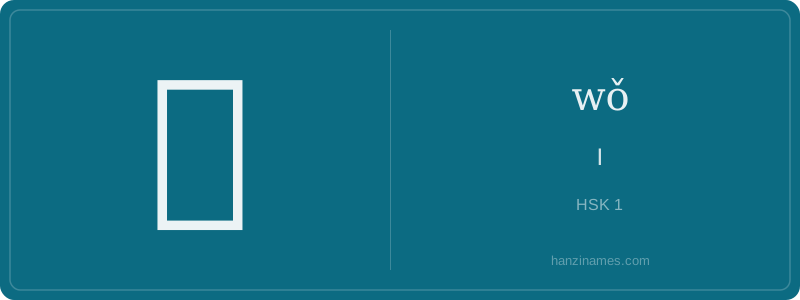
我 appears over 20,000 times in the modern Chinese corpus and is indispensable in daily communication—from ID cards ('姓名: 张三; 性别: 男; 我是北京人') to social media bios. It’s central in idioms like 我行我素 (wǒ xíng wǒ sù, 'to follow one’s own course regardless of others'), documented since the Ming dynasty. In formal documents, it’s standard in self-references like '本人' (běnrén, 'this person'), but 我 remains dominant in spoken and informal written Chinese.
The earliest attested form of 我 appears in bronze inscriptions (c. 11th–3rd century BCE) as a pictograph resembling a weapon with a hand—likely representing 'self' through the idea of wielding power or agency. While its exact oracle-bone form is fragmentary and debated, scholars agree it was phonosemantic by the Warring States period, with 戈 indicating sound and the left component evolving into the modern shape.
Hello, learners! The character 我 (wǒ) is one of the first words you’ll master—it means 'I', 'me', or 'my'. It’s an essential pronoun used constantly in speech and writing. Unlike English, Chinese doesn’t change form for subject/object/possessive—context tells you whether it’s 'I am here', 'He saw me', or 'my book'. Pronounced with a falling-rising tone (third tone), wǒ often changes to a second tone (wó) before another third-tone syllable—like in 我很好 (wó hěn hǎo, 'I’m very well'). Practice this tone shift early!
Writing 我 takes just seven strokes, and its radical 戈 (gē, 'dagger-axe') hints at its ancient martial origins—but don’t worry: today it carries no aggression! The top part (手 + 手-like component) evolved from a hand holding a weapon, symbolizing self-assertion or agency. As a Level 1 HSK character, it appears in over 95% of beginner dialogues—from introducing yourself to ordering food.
Remember: 我 is always singular and never plural. To say 'we', use 我们 (wǒmen)—just add 们 (men), the plural marker for people. You’ll see 我 paired with verbs like 是 (shì, 'to be'), 有 (yǒu, 'to have'), and 喜欢 (xǐhuan, 'to like'). Because it’s so frequent, mastering its tone, stroke order, and usage unlocks fluency faster than almost any other character. Don’t rush—write it slowly five times daily, saying 'wǒ' aloud each time!
Example Sentences
Common Compounds
Similar Characters — Don't Mix These Up
Your First Step into Chinese Culture: Get a Chinese Name
Every journey into Chinese begins with a name. Use our free Chinese name generator to create a meaningful, personalized Chinese name that fits you perfectly.
Get My Chinese Name →