他
Character Story & Explanation
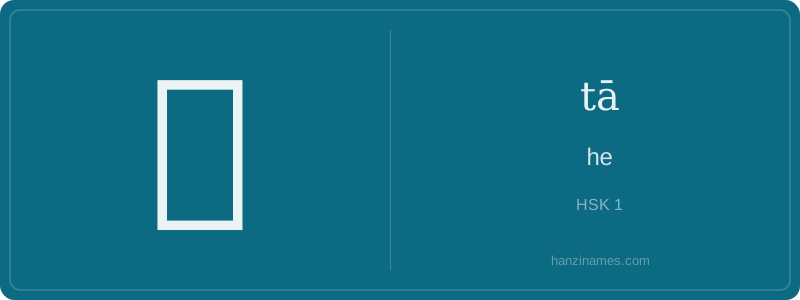
他 has been the standard written form for 'he/him/his' since the May Fourth Movement (1915–1925), when modern vernacular Chinese was codified. Prior to this, classical texts used 他 generically for 'other' or 'third person', without strict gender assignment. Today, it appears ubiquitously: in news headlines ('他当选总统'), textbooks, legal documents, and digital interfaces. A common phrase is '他怎么样?' (Tā zěnmeyàng? — 'How is he?'), used daily in health, work, and social check-ins.
The character is a semantic-phonetic compound: left-side radical 亻(person) signals human reference; right-side 也 (yě, archaic 'also') serves phonetically, approximating tā. While 也 no longer sounds identical, historical phonology confirms this link—Old Chinese *lajʔ evolved into tā via tone and initial consonant shifts documented in Middle Chinese rhyme dictionaries like the Qieyun (601 CE).
The Chinese character 他 (tā) is a third-person singular pronoun meaning 'he', 'him', or 'his'. Unlike English, Mandarin does not inflect for case—context determines whether it functions as subject, object, or possessive. It belongs to the HSK Level 1 vocabulary, making it one of the first characters learners encounter. Its simplicity—just five strokes and the common person radical 亻—reflects its foundational role in everyday communication.
Unlike Western languages with grammatical gender embedded in articles or adjectives (e.g., French 'il' vs. 'elle', German 'er' vs. 'sie'), Mandarin uses the same written form 他 for male referents, while 她 (tā) denotes 'she'—distinguished only by the female radical 女. This orthographic distinction emerged in the early 20th century under Western linguistic influence, replacing the pre-modern gender-neutral 他 for all genders.
In spoken Mandarin, 他 carries no inherent gendered pronunciation—it sounds identical to 她 and 它 (tā, 'it'). Listeners rely entirely on context or visual cues (in writing) to disambiguate. This reflects a broader cultural tendency toward contextual precision over morphological marking—a contrast with Indo-European languages where grammar often encodes gender regardless of relevance to meaning.
Example Sentences
Common Compounds
Similar Characters — Don't Mix These Up
Your First Step into Chinese Culture: Get a Chinese Name
Every journey into Chinese begins with a name. Use our free Chinese name generator to create a meaningful, personalized Chinese name that fits you perfectly.
Get My Chinese Name →