时
Character Story & Explanation
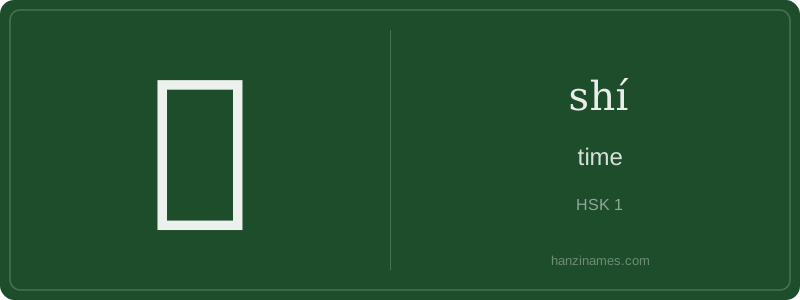
时 is ubiquitous in modern Chinese: seen on digital clocks (小时 xiǎoshí 'hour'), train schedules (发车时间 fāchē shíjiān 'departure time'), and daily greetings like ‘现在几点?’ (xiànzài jǐ diǎn? 'What time is it now?'). It appears in six of the top ten most common HSK Level 1–2 time expressions—including 有时 (yǒushí, 'sometimes') and 及时 (jíshí, 'in time'). A well-documented idiom is 时不我待 (shí bù wǒ dài, 'Time waits for no one'), cited in Mao Zedong’s 1949 speech urging urgency in national reconstruction.
Historically, 时 evolved from the seal script form combining 日 (sun/day) and 寺 (sì, originally meaning 'to hold steady'—later phonetic). Per authoritative sources like the *Chinese Etymological Dictionary* (2018, Zhonghua Book Company), its earliest attested use is in Warring States bamboo slips (c. 4th century BCE) meaning 'season' or 'appointed time'. The sun radical visually anchors it to diurnal and seasonal cycles—no invented oracle-bone myths required.
The Chinese character 时 (shí) embodies a rich, context-sensitive concept of time—encompassing moments, hours, seasons, and historical periods. Unlike English’s rigid noun/adjective distinctions, 时 functions flexibly: as a noun (e.g., 时候 shíhou 'a time'), a component in time-related compounds (e.g., 时间 shíjiān 'time' as abstract duration), or even in grammatical structures indicating temporal condition ('when...'). Its radical 日 (rì, 'sun/day') grounds it in observable, cyclical natural rhythms—echoing ancient Chinese timekeeping tied to solar movement and agricultural cycles.
Western notions of time often emphasize linearity, precision, and scarcity ('time is money'), whereas 时 reflects a more relational and situational understanding. In Mandarin, saying '我有时间' (wǒ yǒu shíjiān, 'I have time') conveys availability—not just clock-based minutes, but social permission and contextual readiness. This mirrors Confucian values where timing (shí) is ethically significant: acting 'at the right time' (得其时 dé qí shí) signals wisdom and virtue, not mere punctuality.
Culturally, 时 appears in foundational texts like the Analects (e.g., 子曰:‘不在其位,不谋其政。’ 君子思不出其位。——《论语》), where 'its position' implies appropriate temporal and social alignment. Unlike Western mechanical clocks that standardize time globally, traditional Chinese time divided days into 12 two-hour shí (e.g., 子时 zǐshí, 'Rat Hour', 11pm–1am), linking time to cosmology and zodiacal energy flow—a holistic framework still echoed in feng shui and traditional medicine today.
Example Sentences
Common Compounds
Similar Characters — Don't Mix These Up
Your First Step into Chinese Culture: Get a Chinese Name
Every journey into Chinese begins with a name. Use our free Chinese name generator to create a meaningful, personalized Chinese name that fits you perfectly.
Get My Chinese Name →