摸
Character Story & Explanation
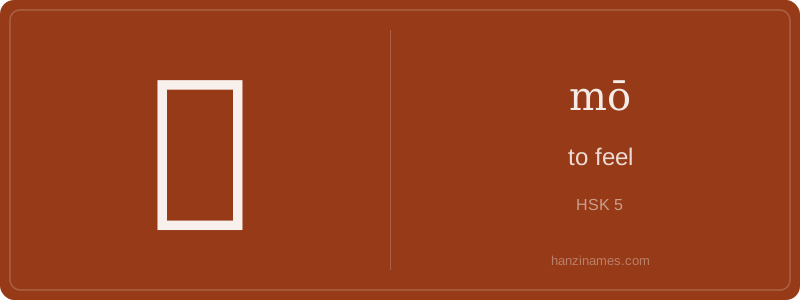
摸 is widely used in daily Mandarin for practical, sensory actions: doctors 摸脉 (mō mài, 'take the pulse') using traditional diagnostic palpation; parents 摸额头 (mō étou, 'feel the forehead') to check for fever; and learners 摸索 (mōsuǒ, 'grope/feel one’s way') when navigating new skills. The idiom 摸着石头过河 (mōzhe shítou guò hé, 'cross the river by feeling stones')—a famous Deng Xiaoping-era metaphor for pragmatic, incremental reform—is documented in official Party publications since the early 1980s.
摸 is a phono-semantic compound: 扌 (hand radical) + 莫 (mò, phonetic component, originally meaning 'sunset' or 'obscure'). Its earliest attested form appears in seal script (c. 3rd century BCE), where the hand element was already standard for manual actions. No oracle bone inscription exists for 摸—it emerged later as tactile terminology formalized in medical and administrative texts.
The Chinese character 摸 (mō) fundamentally conveys tactile exploration—using hands to perceive texture, shape, temperature, or presence without visual confirmation. Unlike English verbs like 'touch' (which can be fleeting) or 'feel' (which may be emotional), 摸 emphasizes deliberate, investigative contact. It appears in both literal contexts (e.g., checking a fever by touching the forehead) and figurative ones (e.g., 'feeling one’s way' through uncertainty). Its hand-radical (扌) anchors it firmly in physical action, distinguishing it from abstract cognition.
In Western cultures, comparable gestures—like a doctor palpating a patient’s abdomen or a blind person reading Braille—are often described with specialized terms ('palpate', 'tactilely explore') rather than a single versatile verb. English lacks an exact equivalent: 'grope' carries negative connotations; 'fumble' implies clumsiness; 'caress' is affectionate. 摸 remains neutral, context-dependent, and culturally unembellished—reflecting the Confucian value of grounded, embodied knowing.
This neutrality enables rich idiomatic use. Phrases like 摸不着头脑 (mō bù zhe tóunǎo, 'can’t grasp the head') express intellectual confusion—not through sight or logic, but via failed tactile metaphor. Such expressions reveal how deeply somatic experience informs Chinese epistemology: understanding is not just 'seeing' or 'thinking', but literally 'feeling out' reality. This contrasts with Western philosophical traditions privileging vision ('insight', 'perspective') or reason over touch.
Example Sentences
Common Compounds
Similar Characters — Don't Mix These Up
Your First Step into Chinese Culture: Get a Chinese Name
Every journey into Chinese begins with a name. Use our free Chinese name generator to create a meaningful, personalized Chinese name that fits you perfectly.
Get My Chinese Name →