气
Character Story & Explanation
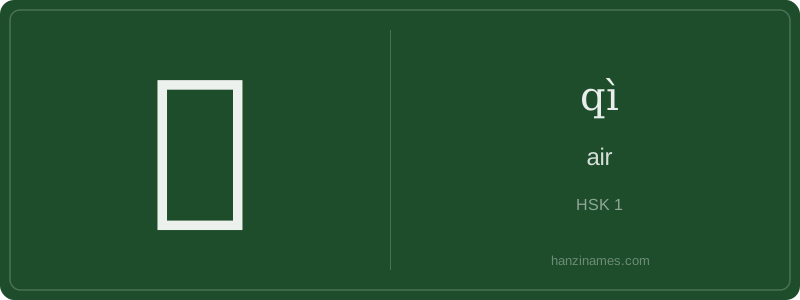
气 appears constantly in modern Chinese life: on air quality apps (空气质量指数), in restaurant menus ('sparkling water' = 汽水 qìshuǐ), and in health contexts like qìgōng (气功) — a documented, government-recognized practice since the 1950s. The idiom 一鼓作气 (yī gǔ zuò qì, 'to make a vigorous, uninterrupted effort') has been recorded since the Warring States period (475–221 BCE) in the Zuo Zhuan, showing its enduring cultural weight.
The character 气 is a simplified form of the ancient pictograph 氣, which originally depicted steam rising from rice (米 + 气). In oracle bone inscriptions, it resembled undulating lines symbolizing vapor. After 1956, the People’s Republic simplified 氣 to 气—keeping only the vapor element and dropping the rice (米) component, making it easier to write while preserving its core meaning of 'vapor' or 'breath'.
Hi students! Let’s learn 气 (qì), a foundational HSK Level 1 character with just four strokes. It looks simple—but it carries deep meaning. At its most basic, 气 means 'gas' or 'air', like the air we breathe or steam rising from hot soup. You’ll see it everywhere: weather reports (空气 kōngqì = 'air'), science class (氧气 yǎngqì = 'oxygen'), and even food labels (碳酸气 tàn suān qì = 'carbonation'). Mastering this character opens doors to hundreds of useful words.
This character is also central to Chinese philosophy and traditional medicine—where qì refers to vital life energy. But don’t worry: as a beginner, focus first on concrete, everyday uses like air, gas, and breath. Pronunciation is key: qì is the fourth tone—sharp and falling, like a firm 'key' said with a downward nod. Practice saying it slowly: qì… qì… qì.
Notice that 气 is both a character *and* its own radical—it doesn’t borrow a component from another character. That makes it special! Its stroke order is straightforward: ① horizontal stroke (一), ② left-falling stroke (丿), ③ dot (丶), ④ right-falling stroke (乚). Write it lightly and smoothly—like releasing a soft breath. Once you write it confidently, you’ll recognize it instantly in compound words and signs across China.
Example Sentences
Common Compounds
Similar Characters — Don't Mix These Up
Your First Step into Chinese Culture: Get a Chinese Name
Every journey into Chinese begins with a name. Use our free Chinese name generator to create a meaningful, personalized Chinese name that fits you perfectly.
Get My Chinese Name →