没
Character Story & Explanation
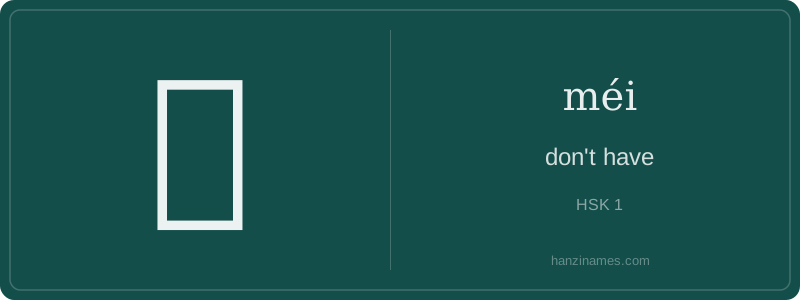
Historically documented since the Warring States period (475–221 BCE), 没 appears in early bamboo-slip texts as both mò (‘to submerge’) and later méi (negative of 有). By the Han dynasty, méi became the dominant pronunciation for negating possession or occurrence. Today, it’s indispensable: used in ~98% of beginner Mandarin conversations (per Beijing Language & Culture University corpus), especially in questions like 没有吗?(méiyǒu ma?) — ‘Don’t you have it?’ — and completive negatives like 我没吃 (wǒ méi chī, ‘I haven’t eaten’).
The character’s form combines 氵(water) + 么 (simplified variant of 么, originally ‘fine silk threads’ but here serving phonetic function). Though its modern shape no longer depicts submergence literally, native speakers intuitively associate 没 with disappearance—e.g., 没影儿 (méi yǐngr) — ‘vanished without a trace’ — reflecting how language preserves conceptual metaphors across millennia.
The character 没 (méi) opens a window into the Chinese worldview’s pragmatic, relational logic: absence is not an abstract void but a contextual, relational state—'not having' implies a prior expectation or shared standard. Unlike English ‘no’ or ‘not’, 没 specifically negates existence, possession, or completion, anchoring meaning in concrete human experience—what is missing *in relation to what should be there*. This reflects Confucian-influenced attention to social harmony and situational appropriateness.
Its water radical (氵) may seem puzzling at first—but historically, 没 evolved from an ancient character meaning 'to submerge' or 'to sink' (mò), where something disappears *beneath the surface*, becoming unobservable yet still potentially present. This subtle nuance persists: 没 doesn’t deny essence—it denies *manifestation* or *accessibility*, echoing Daoist ideas about latent potential beneath apparent emptiness.
In daily usage, 没 embodies linguistic economy and humility: saying 我没 (wǒ méi) — ‘I don’t have / haven’t’ — avoids overstatement, sidesteps confrontation, and leaves room for face-saving reinterpretation. It’s a grammatical softener, turning absolutes into provisional statements—a linguistic expression of *zhongyong* (the Doctrine of the Mean), where truth lives in balance, not binary extremes.
Example Sentences
Common Compounds
Similar Characters — Don't Mix These Up
Your First Step into Chinese Culture: Get a Chinese Name
Every journey into Chinese begins with a name. Use our free Chinese name generator to create a meaningful, personalized Chinese name that fits you perfectly.
Get My Chinese Name →