挡
Character Story & Explanation
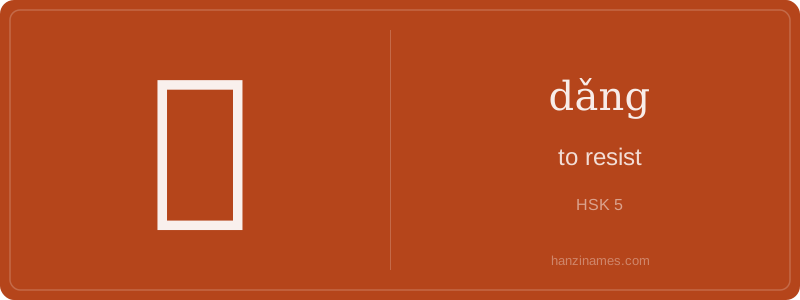
In daily life, 挡 appears ubiquitously: subway riders ‘挡’ the closing doors with their bags; WeChat users ‘挡’ spam by enabling ‘消息免打扰’; and in historical texts like the Ming Shi (1679), generals ‘挡敌于关外’ (resist enemies beyond the pass). Common phrases include ‘挡不住’ (can’t resist/contain) and ‘挡驾’ (a polite refusal of visitors, literally 'block the official’s carriage'). It’s central to idioms like ‘一夫当关,万夫莫挡’ (one man at the pass, ten thousand cannot resist), documented since the Song dynasty.
The character is not pictographic but phono-semantic: 扌 (hand radical) signals action; ‘当’ (dāng/dàng) provides sound and reinforces meaning—‘to face’ or ‘to serve as’. No oracle-bone form exists; its earliest attestation is in seal script (c. 3rd century BCE), showing clear hand + phonetic structure. Today, you’ll see it printed on anti-dust masks sold in Guangzhou pharmacies and handwritten on shop shutters: ‘本店暂不营业,敬请谅解,勿挡门’.
Imagine a Beijing alleyway on a windy autumn afternoon. A street vendor quickly unfolds a heavy blue tarpaulin and braces it against the wall with bamboo poles—'dǎng' in action. This isn’t just blocking wind; it’s an embodied act of resistance: hands pushing, body leaning, will asserting control over chaos. The character 挡 captures that physical and metaphorical pushback—whether shielding a child from rain, halting misinformation online, or standing firm in negotiation.
The radical 扌 (hand) anchors its meaning in human agency: every use implies intentional, bodily intervention. Its nine strokes flow from left to right—three quick taps of the hand radical, then six decisive movements forming ‘当’, a phonetic component also meaning ‘to face’ or ‘to correspond’. That duality—hand + facing—is key: to挡 is not passive shielding but active confrontation.
At HSK 5, 挡 signals a shift from basic verbs to nuanced socio-linguistic action. Learners encounter it in contexts where agency matters: policy debates (‘挡路’), digital life (‘屏蔽’ synonyms), and interpersonal boundaries (‘挡驾’). Unlike generic ‘stop’, 挡 implies effort, positionality, and often moral weight—like a community elder stepping between quarreling neighbors, literally and figuratively holding the line.
Example Sentences
Common Compounds
Similar Characters — Don't Mix These Up
Your First Step into Chinese Culture: Get a Chinese Name
Every journey into Chinese begins with a name. Use our free Chinese name generator to create a meaningful, personalized Chinese name that fits you perfectly.
Get My Chinese Name →