敌
Character Story & Explanation
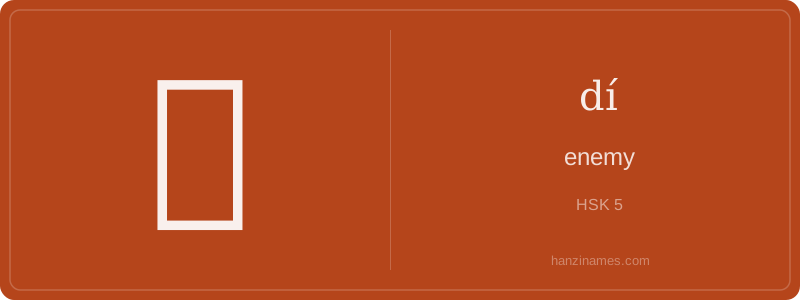
敌 is widely used in modern Chinese across media, education, and official discourse. It appears in HSK-5 vocabulary lists and frequent idioms like 势不两立 (shì bù liǎng lì, 'cannot coexist'), where 敌 implies existential threat. Historically, it features prominently in Sun Tzu’s Art of War (e.g., 知彼知己,百战不殆: ‘Know your enemy and know yourself…’) and Mao Zedong’s political writings, cementing its role in strategic thought.
The character combines 舌 (tongue; radical, hinting at speech/confrontation) and 攵 (pū, ‘to strike’—a variant of 攴), indicating ‘to oppose verbally or physically’. Though not a pictograph, its structure reflects early conceptualization of enmity as both rhetorical and physical contest—documented in bronze inscriptions from the Zhou dynasty (c. 1046–256 BCE).
The Chinese character 敌 (dí) means 'enemy'—a person or force actively opposed to one’s interests, values, or survival. Unlike English ‘enemy’, which often implies personal animosity, 敌 carries strong contextual weight in political, military, and strategic discourse. It appears frequently in historical texts, modern propaganda, and everyday metaphors—e.g., ‘the enemy of progress’—reflecting a collectivist framing where opposition is often systemic rather than purely interpersonal.
In classical Chinese, 敌 originally denoted ‘to oppose’ or ‘to match’ (as in equal strength), evolving semantically toward ‘adversary’ during the Warring States period. Its use in phrases like 敌我矛盾 (dí wǒ máodùn, 'contradiction between enemy and us') underscores its role in Marxist-Leninist political taxonomy adopted in 20th-century China—a conceptual framework with no direct Western equivalent, blending moral, class, and existential dimensions.
Western equivalents like ‘foe’, ‘adversary’, or ‘antagonist’ lack 敌’s institutional gravity and ideological precision. While Shakespeare’s ‘foe’ evokes honor-bound rivalry, and ‘rival’ suggests competition without hostility, 敌 connotes irreconcilable opposition—often dehumanized in wartime rhetoric (e.g., 抗日战争: ‘War of Resistance Against Japan’). This reflects Confucian-influenced distinctions between ‘inner’ (self/kin) and ‘outer’ (other/enemy), sharpened by centuries of frontier conflict and dynastic legitimacy struggles.
Example Sentences
Common Compounds
Similar Characters — Don't Mix These Up
Your First Step into Chinese Culture: Get a Chinese Name
Every journey into Chinese begins with a name. Use our free Chinese name generator to create a meaningful, personalized Chinese name that fits you perfectly.
Get My Chinese Name →