昆
Character Story & Explanation
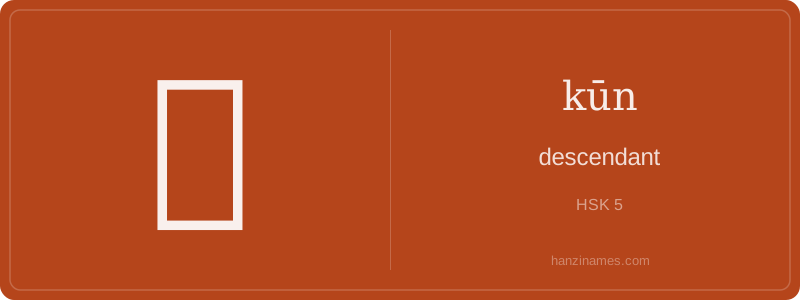
昆 is rarely used alone in modern Mandarin but appears frequently in formal, literary, or historical compounds—especially in kinship terms and classical allusions. It features in the idiom 昆山片玉 (Kūnshān piàn yù), meaning 'a rare gem from Kunshan,' metaphorically praising an outstanding individual from a distinguished family. Historically, 昆 appears in early texts like the *Zuo Zhuan* to denote fraternal seniority, and remains common in surnames (e.g., Kun Bao) and place names (Kunming, though unrelated etymologically).
The character’s form does not derive from ‘sun’ (日) as radical might suggest—its inclusion is phonetic, not semantic. The 日 radical here is a historical artifact from ancient bronze script variants; the original oracle bone form is lost. In daily life, Chinese learners encounter 昆 most often in HSK 5 vocabulary like 昆虫 (kūnchóng, 'insect')—a later semantic extension based on 'multitude' (from 'descendants → many → swarm'), not biology.
The character 昆 (kūn) opens a window into the Confucian-anchored Chinese worldview where lineage, continuity, and intergenerational responsibility are foundational. Though its modern dictionary definition centers on 'descendant', it carries deeper resonance: not merely biological offspring, but inheritors of moral duty, cultural memory, and ancestral virtue—echoing the idea that identity is woven through time, not defined in isolation.
In classical texts, 昆 appears in kinship terms like 昆弟 (kūn dì, elder and younger brothers), reflecting a relational ontology—where selfhood emerges only within hierarchical, affectionate bonds. This mirrors the broader Chinese understanding of personhood as embedded, not autonomous; one’s worth is measured by how faithfully one carries forward the legacy of those before.
Even today, 昆 subtly reinforces collectivist ethics: when used in formal or literary contexts—such as in official documents or ceremonial speeches—it evokes reverence for continuity, reminding speakers that progress must honor roots. It is never neutral: to call someone a 昆裔 (kūn yì, descendant) is to affirm their place in an unbroken human chain—linking filial piety, historical consciousness, and social harmony into one quiet, eight-stroke glyph.
Example Sentences
Common Compounds
Similar Characters — Don't Mix These Up
Your First Step into Chinese Culture: Get a Chinese Name
Every journey into Chinese begins with a name. Use our free Chinese name generator to create a meaningful, personalized Chinese name that fits you perfectly.
Get My Chinese Name →