晕
Character Story & Explanation
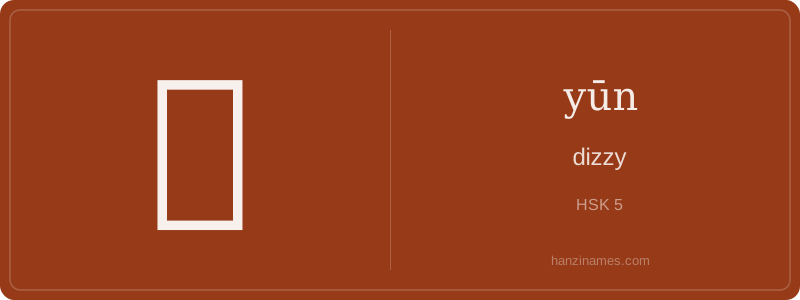
晕 is widely used in modern Mandarin for both medical and colloquial contexts: '头晕' (tóu yūn, 'dizzy head') appears in hospital intake forms and everyday complaints; the idiom '晕头转向' (yūn tóu zhuàn xiàng, 'dizzy-headed and directionless') dates to at least the Ming dynasty and remains common in news reports describing policy confusion or market chaos. In classical texts like the Compendium of Materia Medica (Bencao Gangmu), 晕 describes vertigo as a 'wind-phlegm' disorder.
The character’s form combines 日 (sun, radical) with 昷 (a phonetic component derived from 勛, now simplified). It is not pictographic but phono-semantic: the sun radical hints at luminous phenomena (halos), while the phonetic part guides pronunciation. Its earliest attestation is in Song-era printed texts, not oracle bones — reflecting its later emergence in response to refined diagnostic and literary vocabulary.
The character 晕 (yūn/yùn) embodies a uniquely Chinese perceptual duality: physical disorientation and mental fog are not separate conditions but interwoven states of imbalance. Rooted in the sun radical 日, it originally described the halo around the sun or moon — a natural optical phenomenon perceived as both beautiful and ominous in classical cosmology. This reflects the traditional worldview where external celestial signs mirror internal human harmony or disturbance.
In Daoist and medical thought, dizziness (yūn) signals disrupted qi flow or yin-yang disharmony — not merely a neurological symptom, but a systemic warning. The same character thus bridges astronomy, physiology, and psychology, revealing how pre-modern China saw consciousness, body, and cosmos as a resonant continuum rather than discrete domains.
Its dual pronunciation deepens this cultural layer: yūn denotes acute, bodily dizziness (e.g., fainting), while yùn conveys lingering mental confusion or aesthetic dazzlement (e.g.,晕染, 'ink diffusion'). This phonetic split mirrors a philosophical distinction — between sudden loss of self-possession and subtle, ambient disorientation — echoing Confucian emphasis on situational awareness and Daoist sensitivity to atmospheric nuance.
Example Sentences
Common Compounds
Similar Characters — Don't Mix These Up
Your First Step into Chinese Culture: Get a Chinese Name
Every journey into Chinese begins with a name. Use our free Chinese name generator to create a meaningful, personalized Chinese name that fits you perfectly.
Get My Chinese Name →