暗
Character Story & Explanation
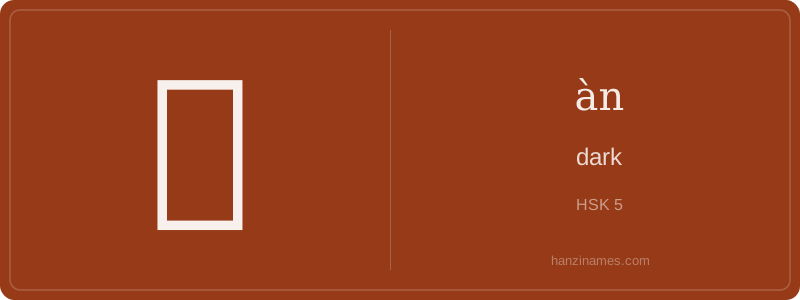
In daily life, 暗 is indispensable: it labels dimmer switches (调暗, tiáo àn), describes covert operations (暗访, ànfǎng — 'covert visit'), and anchors idioms like 暗箭伤人 (àn jiàn shāng rén — 'to stab someone with a hidden arrow', i.e., backstabbing). Historically, it appears in Tang dynasty poetry to evoke melancholy twilight and in Ming-Qing legal texts to denote 'unofficial' or 'clandestine' acts. It’s also central to the phrase 暗度陈仓 (àndù Chéncāng), a famous stratagem from the Records of the Grand Historian (c. 94 BCE), meaning 'to cross the Chen Pass secretly' — symbolizing deception through concealment.
The character is not a pictograph. Its left side 日 is indeed the 'sun' radical — visually recognizable — but the right side 音 ('sound') was selected for phonetic approximation in Early Middle Chinese, not meaning. No archaeological evidence supports a solar eclipse or cave pictogram origin; instead, 暗 exemplifies the phono-semantic compound principle documented in the Shuōwén Jiězì (121 CE), China’s earliest dictionary.
As a detective tracing 暗’s evolution, I begin at its radical: 日 (rì), meaning 'sun' — an ironic anchor for a character meaning 'dark'. This isn’t contradiction but contrast: darkness defined *in relation to light*. The right side, 音 (yīn, 'sound'), is not phonetic in modern pronunciation (àn ≠ yīn), but historically served as a phonetic component in Old Chinese, where *ʔəm* and *ʔəm* were closer. Over time, sound shifts severed the auditory link, leaving a silent clue to its ancient linguistic roots.
The character first appears in standardized form in the Qin dynasty’s small seal script (c. 221 BCE), already with 日 + 音 structure — no oracle bone or bronze inscriptions contain it, confirming it’s a later semantic-phonetic compound, not a primal pictograph. Its 13 strokes encode precision: the sun radical is compact and centered, while the 音 component adds rhythmic complexity — eight strokes including the 'gate' (門) and 'jade' (王) subcomponents, hinting at layered meaning: darkness that *muffles*, *conceals*, or *resonates silently*.
Unlike purely pictorial characters, 暗 reveals how Chinese writing evolved to express abstract conditions — not just physical shade, but obscurity of knowledge, secrecy of intent, or emotional gloom. Its stability across 2,200 years testifies to the power of its dual architecture: 日 grounds it in the observable world; 音 subtly evokes resonance beyond sight — the kind of darkness you *feel* before you see it. That duality makes 暗 a masterclass in literate abstraction.
Example Sentences
Common Compounds
Similar Characters — Don't Mix These Up
Your First Step into Chinese Culture: Get a Chinese Name
Every journey into Chinese begins with a name. Use our free Chinese name generator to create a meaningful, personalized Chinese name that fits you perfectly.
Get My Chinese Name →