未
Character Story & Explanation
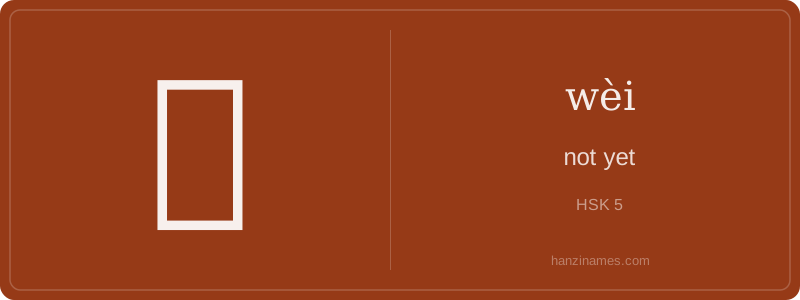
In daily life, 未 is widely used in signs, official documents, and digital interfaces — for example, '未读' (wèidú, 'unread') on WeChat or email apps, or '未完成' (wèi wánchéng, 'incomplete') in online forms. A well-known idiom is 未雨绸缪 (wèi yǔ chóu móu), meaning 'to prepare before it rains' — i.e., foresight — recorded as early as the *Book of Songs* (c. 11th–7th c. BCE). This phrase shows how deeply 未’s sense of 'before something happens' is embedded in Chinese thought.
Historically, 未 appears in bronze inscriptions and the *Shuōwén Jiězì* (121 CE) dictionary as a pictograph depicting the upper, spreading branches of a tree — visually conveying 'not yet grounded', 'still developing'. Though its shape changed over time, this origin remains documented and accepted by paleographers.
Hi students! Let’s learn 未 (wèi), a simple but powerful character meaning 'not yet'. It has only five strokes and belongs to the 木 (mù, 'tree') radical — but don’t let that fool you: it’s not about trees! In ancient Chinese writing, 未 originally represented the *upper branches* of a tree, symbolizing something still growing, incomplete, or not yet mature. That idea evolved naturally into its modern meaning: an action or state that hasn’t happened or been completed.
This character is especially important because it often appears in formal or written Chinese — more than in casual speech. You’ll see it in compound words like 未来 (wèilái, 'future') and 未曾 (wèicéng, 'never before'), where it adds nuance of incompleteness or anticipation. Unlike English’s simple 'not yet', 未 usually pairs with verbs or adjectives and carries a tone of expectation or pending change.
One key thing to remember: 未 is almost never used alone in modern speech — it always appears in compounds or as part of grammatical structures. It’s also commonly confused with 末 (mò, 'end') and 沫 (mò, 'foam'), so pay close attention to stroke order and context. Mastering 未 helps unlock higher-level vocabulary and improves reading fluency — especially for HSK Level 5 learners preparing for formal texts, news, or academic materials.
Example Sentences
Common Compounds
Similar Characters — Don't Mix These Up
Your First Step into Chinese Culture: Get a Chinese Name
Every journey into Chinese begins with a name. Use our free Chinese name generator to create a meaningful, personalized Chinese name that fits you perfectly.
Get My Chinese Name →