村
Character Story & Explanation
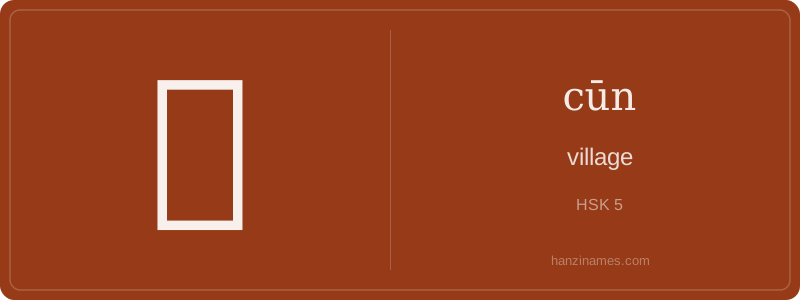
村 is the standard administrative term for China’s smallest rural collective unit—over 500,000 officially designated ‘villages’ exist nationwide, each governed by an elected Village Committee under the Organic Law of Village Committees (1998). It appears in ubiquitous phrases like 村民 (cūnmín, 'villager') and 村委会 (cūnwěihuì, 'Village Committee'), and in idioms such as ‘鸡犬之声相闻,老死不相往来’ (from Laozi), evoking self-sufficient village life. Historically, during the Ming and Qing dynasties, 村 replaced earlier terms like 里 (lǐ) as the dominant grassroots unit in tax and census records.
The character first appeared in clerical script (lìshū) during the Han dynasty—not in oracle bones or bronze inscriptions. Its structure combines 木 (wood/tree, radical) and 寸 (cùn, ‘inch’, phonetic component). While 寸 originally meant ‘wrist’ (a body measurement), here it serves primarily as a sound hint for cūn; no pictographic origin exists. Today, Chinese people see 村 on road signs, ID cards, and WeChat group names—e.g., ‘XX村便民群’ (‘XX Village Public Service Group’).
The character 村 (cūn) embodies the enduring Chinese ideal of rootedness—where human life flourishes in harmony with nature and kinship. Its radical 木 (wood/tree) signals that villages historically grew around forests, orchards, or timber resources, anchoring community identity in land and ecology rather than abstract administration. In classical thought, the village was the foundational unit of Confucian moral order—‘the root of the state’—where filial piety, mutual aid, and seasonal rhythms shaped ethical life.
Unlike Western notions of ‘town’ as a commercial hub, 村 connotes intimacy, interdependence, and generational continuity. Even today, official documents distinguish 村 (administrative village) from 镇 (town) and 市 (city), reflecting a worldview where scale implies relational density, not just population size. The character thus encodes a quiet resistance to anonymity—a reminder that civilization begins not with monuments, but with shared wells, ancestral halls, and rice paddies tended across centuries.
This worldview persists in modern policy: China’s ‘Rural Revitalization Strategy’ (2018–present) uses 村 not as a relic, but as a living site of cultural resilience and ecological innovation. Village-level cooperatives, digital governance platforms, and intangible cultural heritage preservation all operate under the 村 designation—proving that for Chinese society, the village remains both memory and laboratory. To write 村 is to invoke a covenant between people, place, and time.
Example Sentences
Common Compounds
Similar Characters — Don't Mix These Up
Your First Step into Chinese Culture: Get a Chinese Name
Every journey into Chinese begins with a name. Use our free Chinese name generator to create a meaningful, personalized Chinese name that fits you perfectly.
Get My Chinese Name →