某
Character Story & Explanation
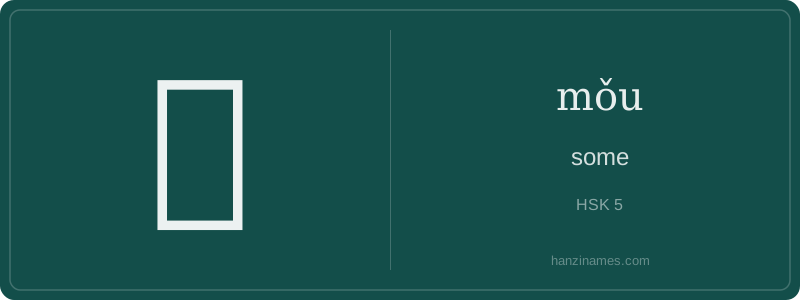
某 is routinely used in Chinese media, legal texts, and education to anonymize real entities—e.g., '某省' (a certain province) in news headlines when withholding location for sensitivity, or '某同学' (a certain classmate) in textbooks to avoid singling out students. It appears in standardized exams (including HSK 5) and official announcements where specificity is unnecessary or inappropriate. The idiom '某事某物' (mǒu shì mǒu wù) — 'some matter, some thing' — is a common rhetorical doubling emphasizing generality.
Historically, 某 evolved from the ancient character for 'plum' ( Plum tree → 木 + 某), but its semantic shift to 'indefinite reference' is well-documented in Han dynasty texts like the *Shuōwén Jiězì* (100 CE), where it was defined as 'a name used when the true name is unknown or withheld'. Its form combines 木 (wood/tree radical) and a phonetic component (mei/mǒu), with no pictographic origin—it’s a phono-semantic compound, not a pictograph.
The Chinese character 某 (mǒu) functions as an indefinite determiner meaning 'some', 'a certain', or 'so-and-so'—used to refer to unspecified people, places, or things without naming them. Unlike English's flexible 'some', 某 is inherently formal and anonymizing: it signals deliberate vagueness, often for privacy, modesty, or rhetorical neutrality. It appears frequently in official documents, news reports, and academic writing—not casual speech—making it a hallmark of written register precision.
In Western contexts, equivalents like 'John Doe', 'X Company', or 'a certain individual' carry similar anonymizing force—but these are phrase-based and culturally loaded (e.g., legal fiction). 某, by contrast, is a single, grammatically versatile character that can modify nouns directly (e.g., 某人, 某地), functioning more like Latin 'quidam' or French 'tel'—yet with stronger bureaucratic and literary resonance in modern Chinese.
Culturally, 某 reflects Confucian-influenced values of discretion and humility: naming is an act of authority or intimacy; withholding names expresses restraint or respect for boundaries. In contrast, Western anonymity often stems from legal rights (e.g., privacy laws) or journalistic ethics. This subtle divergence makes 某 not just a lexical placeholder—but a linguistic marker of relational and institutional decorum in Chinese discourse.
Example Sentences
Common Compounds
Similar Characters — Don't Mix These Up
Your First Step into Chinese Culture: Get a Chinese Name
Every journey into Chinese begins with a name. Use our free Chinese name generator to create a meaningful, personalized Chinese name that fits you perfectly.
Get My Chinese Name →