柔
Character Story & Explanation
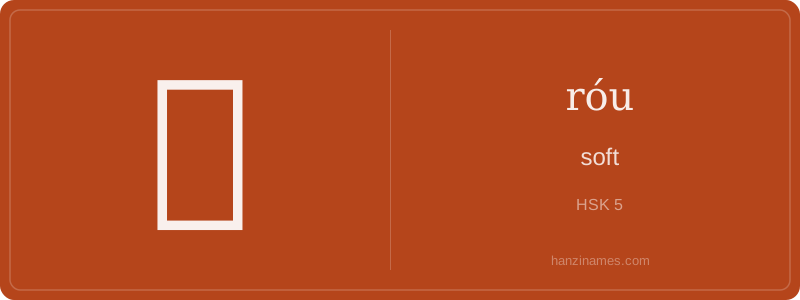
In modern Chinese, 柔 appears frequently in compound words expressing adaptable strength: 柔道 (rōudào, judo), 柔性 (róuxìng, flexibility/resilience), and 柔光 (róuguāng, soft light). It’s central to martial arts philosophy (e.g., tai chi’s 'four ounces deflect a thousand pounds') and widely used in advertising for skincare ('柔滑肌肤', róuhuá jīfū—'soft-smooth skin'). The idiom 以柔克刚 (yǐ róu kè gāng—'use softness to overcome hardness') is cited in official media discussing diplomacy and conflict resolution.
The character’s form dates to the seal script (c. 3rd century BCE), where it clearly combines 木 (wood, radical) and 呂 (lǚ, originally depicting two mouth-like units, later phonetic). No oracle bone form survives, but bronze inscriptions confirm its use by the late Zhou for qualities like 'pliant wood' or 'yielding conduct'. Today, Chinese students learn it in HSK 5 textbooks as part of vocabulary on interpersonal sensitivity and material properties.
As an archaeologist brushing dust from a Han dynasty bamboo slip, I find 柔 inscribed in elegant clerical script—not as a mere descriptor of texture, but as a philosophical artifact. Its presence in early medical texts like the *Huangdi Neijing* reveals how 'softness' was understood as vital physiological balance: supple tendons, yielding breath, adaptive qi flow—never weakness, but resilient pliancy encoded in ink.
Beneath the lacquer of a Warring States bronze bell inscription, 柔 appears alongside terms for harmony and restraint, confirming its role in Confucian statecraft: rulers were urged to govern with 柔德 (róu dé)—'soft virtue'—a calibrated blend of compassion and flexibility that prevented rebellion without sacrificing authority. This wasn’t passive gentleness; it was strategic malleability, honed over centuries of diplomatic negotiation and ritual practice.
Excavations at Mawangdui unearthed silk manuscripts where 柔 anchors Taoist cosmology: 'The softest thing in the world overcomes the hardest' (*Daodejing* Ch. 43). Here, the character functions like a glyph of natural law—its 木 (wood) radical grounding it in organic growth, while the 呂 component (originally picturing paired bells or spinal vertebrae) suggests resonance and rhythm. To ancient scribes, 柔 was not an adjective—it was a principle of enduring power.
Example Sentences
Common Compounds
Similar Characters — Don't Mix These Up
Your First Step into Chinese Culture: Get a Chinese Name
Every journey into Chinese begins with a name. Use our free Chinese name generator to create a meaningful, personalized Chinese name that fits you perfectly.
Get My Chinese Name →