棋
Character Story & Explanation
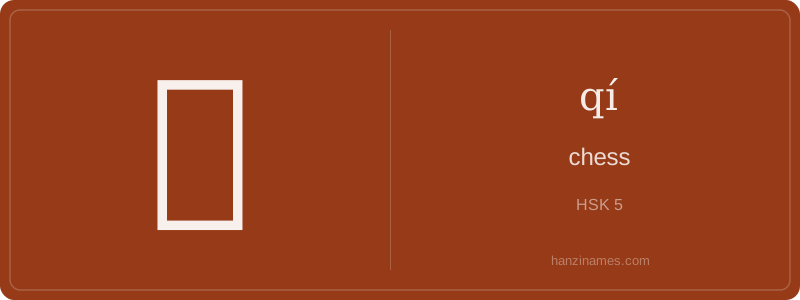
棋 is deeply embedded in daily life and classical literature. It appears in idioms like ‘棋逢对手’ (qí féng duìshǒu, 'rivals of equal skill') and historical texts such as the Shuō Yuàn (c. 1st century BCE), which praises Go as a tool for cultivating virtue and foresight. Modern usage includes terms like '下棋' (xià qí, 'to play chess')—a common weekend activity in parks across Beijing and Chengdu, where elders gather under willow trees.
The character’s form dates to the Warring States period (475–221 BCE) bronze inscriptions. It combines 木 (wood, indicating material) and 其 (a phonetic component, not the pronoun 其). No pictographic origin exists—it evolved as a phono-semantic compound, reflecting its functional role in naming games rather than depicting them.
Hi students! Let’s explore 棋 (qí), a character you’ll encounter often in Chinese culture. Though it literally means 'chess' or 'board game', it doesn’t refer to just one game—it’s the umbrella term for traditional strategy games like Go (围棋 wéiqí), Chinese chess (象棋 xiàngqí), and even international chess (国际象棋 guójì xiàngqí). The character reflects how deeply strategic thinking is valued in Chinese tradition—games aren’t just play; they’re metaphors for warfare, philosophy, and self-cultivation.
Notice the radical 木 (mù)—'tree' or 'wood'. This tells us the original boards and pieces were made of wood—a historically accurate detail! In ancient China, high-quality wooden game sets were prized possessions among scholars and officials. Even today, fine rosewood Go boards are treasured heirlooms. So when you see 木 in 棋, think: 'crafted with care, played with wisdom'.
Don’t confuse 棋 with other 'qí' sounds—like 其 (qí, 'its'), 期 (qī, 'period'), or 骑 (qí, 'to ride'). Its 12 strokes follow a clear structure: left-side 木 (4 strokes), right-side 其 (8 strokes). Practice writing it slowly: wood first, then the 'its'-like component—but remember: this 其 is not the pronoun—it’s a phonetic clue hinting at pronunciation, not meaning.
Example Sentences
Common Compounds
Similar Characters — Don't Mix These Up
Your First Step into Chinese Culture: Get a Chinese Name
Every journey into Chinese begins with a name. Use our free Chinese name generator to create a meaningful, personalized Chinese name that fits you perfectly.
Get My Chinese Name →