椒
Character Story & Explanation
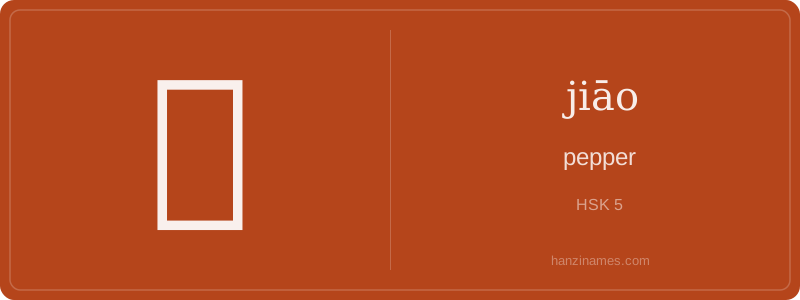
椒 appears in over 2,000 years of documented usage: Confucius famously said ‘not eating food without proper seasoning, nor sitting down without proper jiāo’ (Analects 10.8), highlighting its ritual importance in Zhou dynasty banquets. Today, it’s indispensable in Sichuan cuisine—huājiāo (Sichuan pepper) defines ‘málà’ (numbing-spicy) flavor, used in mapo tofu and hotpot. The idiom ‘椒兰之室’ (jiāo lán zhī shì) — ‘a room fragrant with pepper and orchid’ — metaphorically describes an environment of noble influence, attested in Han dynasty texts like the Hanshu.
The character evolved from seal script (c. 3rd c. BCE), where 木 + 叔 clearly represented a tree bearing small, clustered fruits (peppercorns). ‘叔’ originally depicted a hand holding a stick—later phoneticized—confirming 椒 as a phono-semantic compound, not a pictograph. No oracle bone form survives, but bronze inscriptions show early use in ritual offerings.
椒 (jiāo) is far more than a botanical term for 'pepper'—it embodies China’s ancient sensory philosophy, where taste, aroma, and medicinal virtue converge. In classical texts like the Shennong Bencao Jing, Sichuan pepper (huājiāo) was classified not just as spice but as a warming, qi-regulating herb vital to balancing yin-yang in the body. This reflects a worldview where food, medicine, and cosmology are inseparable.
The character’s wood radical (木) anchors it in nature’s living systems—pepper grows on prickly shrubs or small trees, not vines or herbs. Its twelve strokes echo careful cultivation: the left side (木) signifies rootedness; the right (叔) historically denoted ‘younger uncle’, implying familial hierarchy and generational continuity—just as pepper plants require attentive pruning and multi-year care to bear fruit.
In Chinese thought, jiāo evokes *qi* movement: its numbing heat (má) stimulates circulation and dispels damp-cold, mirroring Daoist ideals of dynamic equilibrium. Even today, chefs and TCM practitioners speak of ‘jiāo’s rising energy’—a linguistic fossil of pre-scientific ecology, where flavor is physiology, and writing is a map of embodied knowledge.
Example Sentences
Common Compounds
Similar Characters — Don't Mix These Up
Your First Step into Chinese Culture: Get a Chinese Name
Every journey into Chinese begins with a name. Use our free Chinese name generator to create a meaningful, personalized Chinese name that fits you perfectly.
Get My Chinese Name →