欠
Character Story & Explanation
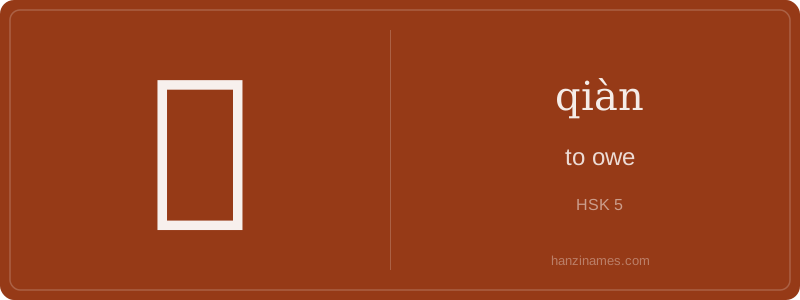
In daily life, 欠 is ubiquitous in financial, legal, and interpersonal contexts. It appears in bank statements (欠款 qiànkuǎn, 'outstanding payment'), tax notices (欠税 qiànshuì), and WeChat Pay reminders ('您有一笔待还欠款'). A common idiom is 欠债还钱 (qiàn zhài huán qián) — 'debts must be repaid' — reflecting traditional commercial ethics documented since the Ming dynasty. Modern courts use 欠薪 (qiànxīn, 'unpaid wages') in labor dispute rulings, a term codified in China’s 2008 Labor Contract Law.
The character’s form is a documented pictograph: oracle bone and bronze inscriptions show a kneeling figure with an open mouth (⺈ + 人), representing 'yawning' or 'exhaling' — a physiological sign of deficiency or exhaustion. By the Warring States period, it acquired the meaning 'to lack', then 'to owe' during Han dynasty administrative texts, as recorded in the Shuōwén Jiězì (100 CE).
The character 欠 (qiàn) visually captures the posture of someone with an open mouth—originally depicting a person yawning or breathing out, which later extended metaphorically to 'lacking' or 'owing'. Its four-stroke simplicity belies deep semantic evolution: from physical absence (e.g., missing breath) to abstract deficit (money, duty, respect). This conceptual leap mirrors how Chinese often grounds abstract ideas in bodily experience—a hallmark of its logographic logic.
As a radical, 欠 appears in characters related to deficiency or vocal action—like 歌 (gē, 'song') and 欢 (huān, 'joy'), both involving vocal expression. Though it no longer functions primarily as a 'yawn' signifier today, its presence subtly echoes states of incompleteness: when you owe money, something is literally *missing* from your balance; when you owe an apology, emotional reciprocity is absent. This duality makes it culturally resonant beyond finance.
In modern usage, 欠 carries quiet moral weight. To say 我欠你一个人情 (Wǒ qiàn nǐ yī gè rénqíng) isn’t just about debt—it’s acknowledging a social obligation rooted in guānxi (relationship ethics). Unlike Western ‘IOUs’, this debt implies future goodwill, not legal enforcement. The character thus embodies Confucian relational reciprocity: owing isn’t shameful—it’s the first step toward harmonious exchange. Mastery of 欠 opens doors to understanding China’s implicit social contracts.
Example Sentences
Common Compounds
Similar Characters — Don't Mix These Up
Your First Step into Chinese Culture: Get a Chinese Name
Every journey into Chinese begins with a name. Use our free Chinese name generator to create a meaningful, personalized Chinese name that fits you perfectly.
Get My Chinese Name →