欣
Character Story & Explanation
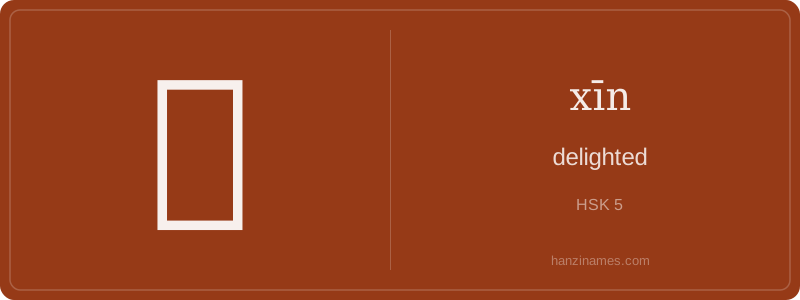
欣 is widely used in modern Standard Chinese in formal and semi-formal contexts — especially in media, education, and official communications. It appears in common terms like 欣赏 (xīnshǎng, 'to appreciate'), 欣然 (xīnrán, 'willingly/with pleasure'), and 欣慰 (xīnwèi, 'heartened/reassured'). The idiom 欣喜若狂 (xīnxǐ ruò kuáng, 'ecstatic') dates back to Ming-Qing vernacular literature and remains in use today. Government reports often use 欣闻 (xīn wén, 'pleased to hear') to express official delight about positive developments.
The character’s earliest attested form appears in bronze inscriptions of the Warring States period (475–221 BCE), where it combines 斤 (a phonetic element related to 'cutting' or 'clarity') and 欠 (a semantic-phonetic component). Scholars agree it evolved from a word for 'joyful singing' — not a pictograph, but a phono-semantic compound. Its current shape reflects standardization during the Han dynasty.
Hi students! Let’s explore 欣 (xīn), a beautiful character meaning 'happy' or 'delighted'. Though it looks simple—just 8 strokes—it carries warm, positive energy. It’s not used alone in modern speech (you won’t say *‘I am xīn’* like ‘I am happy’), but appears frequently in compound words and formal expressions. Think of it as the elegant, literary cousin of 快乐 (kuàilè) — more refined, often found in writing, speeches, or polite conversation.
Notice its radical: 欠 (qiàn), meaning 'to lack' or 'to yawn' — yes, really! But here, it’s a phonetic-semantic component: while 欠 gives a hint to pronunciation (xīn sounds faintly like qiàn in Old Chinese), the left part 斤 (jīn, an axe-like shape) is actually a simplified form of 欣’s ancient variant, originally linked to joyous singing or clapping. So 欣 evokes joyful expression — not just feeling, but outward delight.
This character appears in HSK Level 5, which means it’s common in upper-intermediate reading — newspapers, essays, and official announcements. You’ll see it in phrases like 欣赏 (xīnshǎng, 'to appreciate') and 欣喜 (xīnxǐ, 'great joy'). Don’t confuse it with 喜 (xǐ), which is more basic and colloquial — 欣 adds nuance: calm, heartfelt, even grateful happiness. Practice it with care — its elegance lies in balance!
Example Sentences
Common Compounds
Similar Characters — Don't Mix These Up
Your First Step into Chinese Culture: Get a Chinese Name
Every journey into Chinese begins with a name. Use our free Chinese name generator to create a meaningful, personalized Chinese name that fits you perfectly.
Get My Chinese Name →