歇
Character Story & Explanation
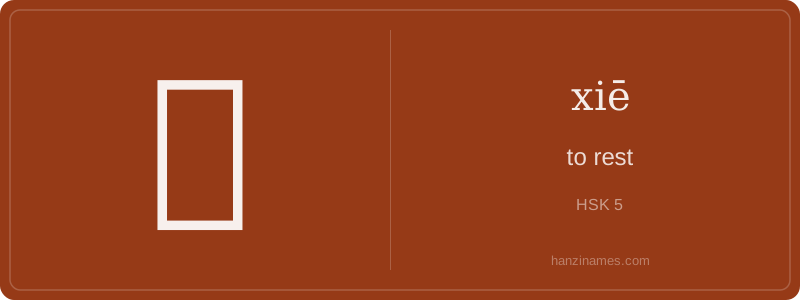
In modern Mandarin, 歇 is widely used in both formal and colloquial contexts — especially in northern dialects and spoken language — to mean ‘to take a break’ or ‘to stop temporarily’. It appears in common phrases like ‘歇会儿’ (xiē huìr, ‘rest for a while’) and ‘歇业’ (xiēyè, ‘suspend business’). Historically, it was standard in imperial postal systems: ‘驿歇’ (yì xiē) denoted official rest stops for messengers. The HSK 5 textbook Integrated Chinese Level 2 Part 2 explicitly teaches 歇 as a key verb for temporary cessation.
The character’s written form has no pictographic origin — it’s a later semantic-phonetic compound. No oracle bone or bronze inscriptions contain 歇. Instead, picture this: A Beijing taxi driver, after a 12-hour shift, says to his colleague, ‘我得赶紧歇会儿!’ — slamming the door, stretching, and inhaling deeply. That moment — the physical release, the open mouth, the pause — is 歇 in action.
Our detective begins at the crime scene: the character 歇, found in texts dating back to the Han dynasty. Its radical 欠 (qiàn) — meaning 'to yawn' or 'to lack' — appears on the right, a clue pointing to bodily exertion and the need for pause. The left side, 葛 (gé), originally a phonetic component referencing a type of vine or hemp fabric, later simplified to (a variant of 葛) but now functions almost exclusively as a sound hint for xiē. This structure reflects classical Chinese’s 'semantic-phonetic' design: one part hints at meaning (欠 = breath, fatigue), the other at pronunciation.
Zooming in on the radical 欠, we find it consistently linked to mouth-related actions: yawn, sigh, exhale — all involuntary signs of tiredness or depletion. In 歇, this isn’t metaphorical; it’s physiological evidence. Ancient scribes didn’t just invent abstract rest — they encoded the *act* of pausing mid-breath, mid-effort. The character doesn’t mean ‘sleep’ or ‘nap’; it means ‘to halt activity temporarily’, often with visible relief — like a laborer leaning on a hoe, mouth slightly open, catching breath. That visceral detail is preserved in every stroke.
Our forensic analysis confirms no oracle bone or bronze script forms of 歇 survive — it first appears reliably in clerical script (lìshū) inscriptions and early dictionaries like the Shuōwén Jiězì (121 CE), where it’s defined as ‘to stop, to rest, to cease’. No mythical origin story exists in historical records — only pragmatic usage: farmers resting between rows, couriers changing horses at post stations (where 歇 was literally posted on relay inns: 歇马处), and poets invoking it to mark emotional or physical suspension. It’s a workhorse character — unglamorous, precise, deeply embodied.
Example Sentences
Common Compounds
Similar Characters — Don't Mix These Up
Your First Step into Chinese Culture: Get a Chinese Name
Every journey into Chinese begins with a name. Use our free Chinese name generator to create a meaningful, personalized Chinese name that fits you perfectly.
Get My Chinese Name →