欧
Character Story & Explanation
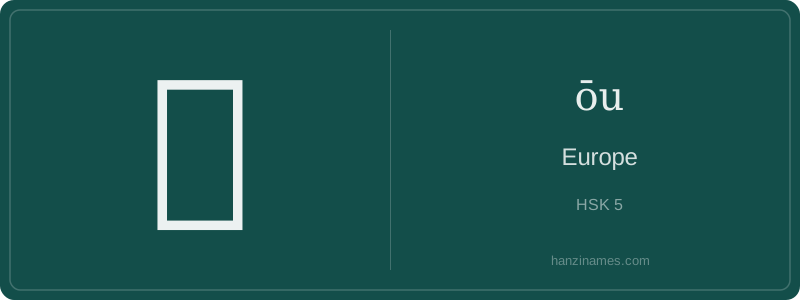
In Shanghai’s Pudong International Airport, travelers glance at departure boards showing flights to 欧洲 (Ōuzhōu, Europe)—a term used daily in news headlines, business contracts, and university syllabi. The character 欧 is never used alone in modern Mandarin; it always appears in compounds denoting geography (欧洲), institutions (欧盟), currency (欧元), or diplomacy (中欧关系). It’s absent from classical texts and only gained standardized usage after the 1920s, when the National Language Unification Commission formalized transliteration rules for foreign place names.
The character 欧 has no ancient pictographic origin—it was created during the Qing dynasty’s engagement with Western cartography. Its form combines the phonetic component 区 (qū, now simplified) and the radical 欠 (qiàn), likely chosen for visual balance rather than semantic relevance. Modern learners encounter it most often on bilingual signage, EU-China trade agreements, and HSK 5 reading passages about globalization.
The character 欧 (ōu) is a phonetic-semantic compound used almost exclusively as a shorthand for Europe or things related to it. Though its radical 欠 (qiàn, 'to lack') might suggest a connection to speech or breath, the character’s meaning is purely phonetic—it was borrowed for its sound to transcribe the foreign word 'Europe' in late Qing and Republican-era transliterations. It carries no native Chinese semantic weight beyond this loan function.
Historically, 欧 entered modern Chinese via early 19th-century Western contact, appearing first in missionary texts and diplomatic documents. Unlike ancient characters with pictographic origins, 欧 has no oracle bone or bronze script form—it’s a relatively recent creation (early 1800s), designed to approximate the 'ou' sound in 'Europe'. Its eight-stroke structure balances simplicity and recognizability, making it ideal for frequent use in news, education, and trade contexts.
Today, 欧 appears ubiquitously in compound terms like 欧盟 (Ōuméng, EU), 欧元 (Ōuyuán, euro), and 中欧 (Zhōng’ōu, Sino-European). It rarely stands alone—unlike native Chinese morphemes, it functions almost entirely as a bound morpheme. Learners at HSK 5 encounter it not as a root concept but as a key lexical building block for global geography and international relations vocabulary.
Example Sentences
Common Compounds
Similar Characters — Don't Mix These Up
Your First Step into Chinese Culture: Get a Chinese Name
Every journey into Chinese begins with a name. Use our free Chinese name generator to create a meaningful, personalized Chinese name that fits you perfectly.
Get My Chinese Name →