归
Character Story & Explanation
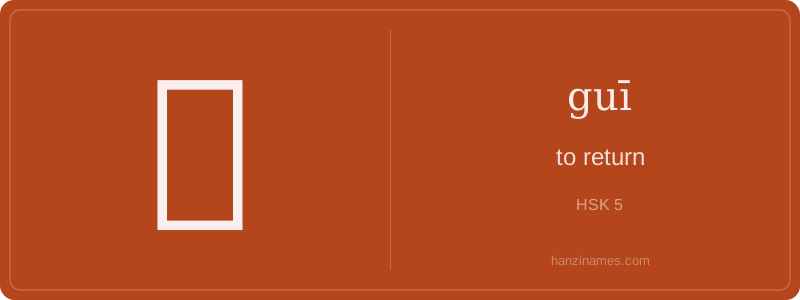
归 is ubiquitous in daily Chinese: used in travel announcements (‘列车即将归站’), legal documents (‘产权归甲方所有’), and emotional farewells (‘早些归家’). It appears in idioms like ‘殊途同归’ (shū tú tóng guī, 'different paths lead to the same destination'), emphasizing convergence over divergence—a hallmark of traditional Chinese logic. Historically, it features in Tang poetry (e.g., Wang Wei’s ‘归嵩山作’) and Ming-Qing legal codes denoting property restitution.
The character’s form evolved from seal script, where 彐 (jì, ‘hut’ or ‘broom’ radical) combined with 女 (nǚ, ‘woman’) — reflecting ancient practices where marriage involved a woman ‘returning’ to her husband’s household. Though not pictographic, its structure encodes social ritual: the top stroke suggests shelter; the lower part grounds it in human relationship.
At its core, 归 (guī) embodies the Chinese philosophical ideal of returning—not just physically, but existentially—to one’s origin, harmony, or rightful place. This reflects Confucian values of filial duty and social order, where ‘returning’ signifies reintegration into family, community, or moral alignment. Unlike Western notions of linear progress, 归 evokes cyclical belonging: the migrant returns home, the soul returns to ancestors, the ruler returns power to virtue.
The character also carries Daoist resonance: water归 sea, qi归 dan tian, thoughts归 stillness—each a natural reversion to source. In classical texts like the *Dao De Jing*, ‘returning’ (反, fǎn) and ‘returning home’ (归) are closely linked concepts denoting restoration of balance. Thus, 归 is less about arrival than about resonance—with roots, rhythm, and relational wholeness.
In modern usage, 归 retains this deep cultural gravity. Saying ‘我归了’ (wǒ guī le) isn’t just ‘I’m going back’—it subtly conveys completion, accountability, or even quiet resignation. Even in bureaucratic terms like ‘归属’ (guīshǔ, ‘belonging to’), 归 implies ethical stewardship, not mere administrative assignment. To understand 归 is to glimpse how Chinese thought locates identity not in isolated selfhood, but in dynamic, reverent return.
Example Sentences
Common Compounds
Similar Characters — Don't Mix These Up
Your First Step into Chinese Culture: Get a Chinese Name
Every journey into Chinese begins with a name. Use our free Chinese name generator to create a meaningful, personalized Chinese name that fits you perfectly.
Get My Chinese Name →