毒
Character Story & Explanation
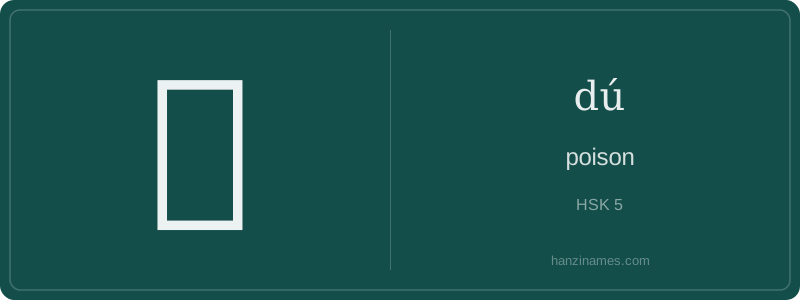
In contemporary China, 毒 appears daily in public health campaigns, drug enforcement notices, and food safety warnings—most visibly on government posters reading ‘珍爱生命,远离毒品’ (Cherish life, stay far from drugs). It’s central to the nationwide anti-drug initiative led by the National Narcotics Control Commission, with 毒品犯罪 (drug-related crimes) carrying severe penalties under Article 347 of China’s Criminal Law. The idiom ‘以毒攻毒’ (yǐ dú gōng dú, ‘using poison to counter poison’) is widely cited in traditional Chinese medicine and modern problem-solving rhetoric.
The character’s earliest attested form appears in bronze inscriptions of the Western Zhou (c. 1046–771 BCE), where it depicted a scorpion-like creature above a container—reflecting early associations with venomous animals and harmful substances. By the Han dynasty, the shape stabilized into its modern structure, with the ‘mother’ radical serving as a phonetic anchor (dú shares sound with 毒’s ancient variant readings), not a semantic one.
The character 毒 (dú) carries visceral weight in Chinese—it’s not just ‘poison’ as a chemical substance, but a linguistic vessel for danger, corruption, and moral decay. Its radical 母 (mǔ, ‘mother’) is historically misleading: though it appears visually, scholars confirm this is a phonetic component from ancient forms (not semantic), while the upper part (丶+一+冖) evolved from older glyphs representing toxicity or venomous creatures. This mismatch between form and meaning reflects how Chinese characters often prioritize sound and historical usage over literal pictorial logic.
At HSK Level 5, 毒 signals advanced vocabulary mastery—appearing in medical, legal, environmental, and metaphorical contexts. Learners encounter it in compound words like 毒品 (drugs), 毒害 (to poison/harm), and even internet slang like 毒鸡汤 (‘toxic inspirational quotes’). Its tone (second tone) is stable and emphatic, making pronunciation relatively straightforward—but its semantic range demands cultural awareness to avoid missteps.
Unlike English ‘poison’, which leans biological or literal, 毒 frequently extends into abstract harm: toxic relationships (毒关系), toxic work culture (毒职场), or even viral misinformation (毒信息). This conceptual elasticity mirrors Confucian and Daoist ideas about internal imbalance—where ‘poison’ isn’t only ingested, but cultivated through greed, deception, or neglect. Understanding 毒 thus means grasping both pharmacology and philosophy in one stroke.
Example Sentences
Common Compounds
Similar Characters — Don't Mix These Up
Your First Step into Chinese Culture: Get a Chinese Name
Every journey into Chinese begins with a name. Use our free Chinese name generator to create a meaningful, personalized Chinese name that fits you perfectly.
Get My Chinese Name →