毫
Character Story & Explanation
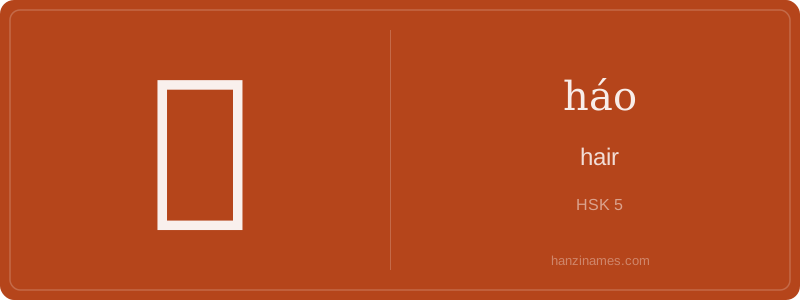
In daily Chinese usage, 毫 is overwhelmingly found in negative constructions meaning 'not the slightest'—as in 毫不犹豫 (háo bù yóu yù, 'not the slightest hesitation') or 毫无保留 (háo wú bǎo liú, 'without the slightest reservation'). These phrases are ubiquitous in formal writing, news reports, and political speeches. The HSK 5 exam frequently tests its collocation with negation particles (毫 + 不/无/未). Historically, it appears in Song dynasty mathematical treatises like *The Sea-Mirror of Circle Measurements*, where it denotes decimal subdivisions.
The character’s form is well-documented: it combines radical 毛 (‘hair’, indicating fineness) with 乚 (yǐn), a variant of 乙—a phonetic component with historical ties to ‘curved line’ or ‘terminal mark’. No oracle bone form exists; its earliest attestation is in seal script (c. 3rd c. BCE), already showing this structural logic—no invention needed.
As an archaeologist brushing dust from a Han dynasty bamboo slip, I find 毫 etched not as a literal hair—but as a unit of astonishing precision: one-tenth of a *lí*, itself one-thousandth of a *zhàng*. This character emerged not from scalp but from metrology—measuring the finest traceable increment in ancient Chinese mathematics and engineering. Its radical 毛 (hair) anchors it in tangible fineness; the right side 乚 (a curved stroke) evolved from ancient forms denoting ‘subtle boundary’ or ‘terminal point’, reflecting how early scribes conceptualized imperceptible thresholds.
The character’s semantic journey reveals a profound cultural pivot: from physical hair to abstract infinitesimal quantity. In excavated Qin legal texts, 毫 appears in land survey records specifying boundary discrepancies ‘not exceeding one *háo*’—proof that by 3rd century BCE, it functioned as a standardized micro-unit. Unlike pictographic characters frozen in time, 毫 fossilizes a cognitive leap: the human mind quantifying the nearly invisible, turning biology into calculus.
Its durability across 2,200 years speaks to linguistic resilience. While modern speakers rarely measure rice grains in *háo*, the character survives in high-stakes domains: precision machining tolerances (±0.01 mm), pharmaceutical dosing, and even AI training metrics ('loss reduced by *háo*'). Like a carbon-dated seed sprouting in a lab, 毫 bridges Warring States metrology and quantum computing—always signifying what lies just beyond naked perception, yet rigorously defined.
Example Sentences
Common Compounds
Similar Characters — Don't Mix These Up
Your First Step into Chinese Culture: Get a Chinese Name
Every journey into Chinese begins with a name. Use our free Chinese name generator to create a meaningful, personalized Chinese name that fits you perfectly.
Get My Chinese Name →