氛
Character Story & Explanation
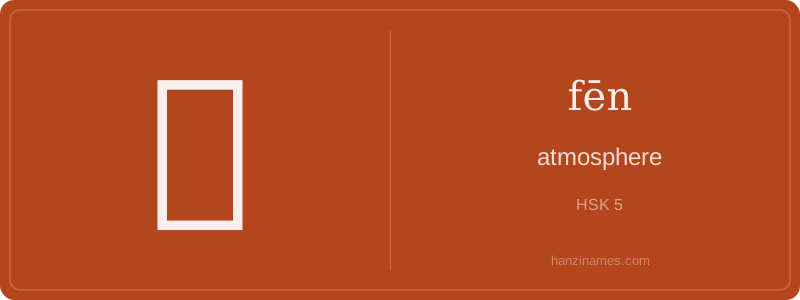
In modern Chinese, 氛 is almost exclusively used in compound words denoting intangible atmospheres — especially in formal, literary, or media contexts. It appears in official reports (e.g., ‘营造…氛围’ — 'create an atmosphere of…'), political speeches, education policy documents, and cultural criticism. The phrase 和谐氛围 (héxié fēnwéi, 'harmonious atmosphere') is widely cited in government white papers since the 2000s. It rarely stands alone and never refers to weather or physical air quality — that role belongs to 气 (qì) or 雾 (wù).
The character’s form has no verified pictographic origin (no oracle bone or bronze script precursors exist for 氛). It first appears reliably in Han dynasty clerical script as a newly coined character combining 气 + 分. Today, Chinese learners most commonly encounter it in classroom settings — teachers say, “注意课堂氛围!” (“Pay attention to the classroom atmosphere!”) — making it a staple of HSK 5 oral and written expression.
Our detective begins at the crime scene: the character 氛, first documented in seal script (c. 3rd century BCE) as a compound of 气 (qì, 'vital air' or 'breath') and 分 (fēn, 'to divide' or 'to separate'). Early inscriptions show it representing a subtle, pervasive atmospheric presence — not just physical vapor, but an invisible influence, like the oppressive stillness before a storm. Its radical 气 signals its elemental domain: the unseen medium through which energy, emotion, and even contagion move.
Zooming in on the suspect’s modus operandi: 分 acts not as a phonetic component alone (though it *does* provide the sound fēn), but as a semantic amplifier — suggesting dispersion, diffusion, and permeation. This duality is key: 氛 isn’t static mist; it’s *miasma* — air that carries meaning, mood, or danger across boundaries. In classical medical texts like the *Huangdi Neijing*, 氛 described pathogenic vapors rising from swamps, believed to transmit disease — a pre-scientific grasp of airborne transmission.
Fast-forward to modern forensics: while ‘miasma’ sounds archaic in English, 氛 thrives in contemporary Chinese as a sophisticated abstraction. It never means literal fog — that’s 雾 (wù). Instead, 氛 exclusively denotes *atmosphere* in the qualitative, emotional, or ideological sense: the charged air of a negotiation, the patriotic fervor at a rally, or the tense silence in a courtroom. Its eight-stroke structure — written swiftly but deliberately — reflects how effortlessly Chinese speakers imbue ordinary spaces with layered, intangible significance.
Example Sentences
Common Compounds
Similar Characters — Don't Mix These Up
Your First Step into Chinese Culture: Get a Chinese Name
Every journey into Chinese begins with a name. Use our free Chinese name generator to create a meaningful, personalized Chinese name that fits you perfectly.
Get My Chinese Name →