池
Character Story & Explanation
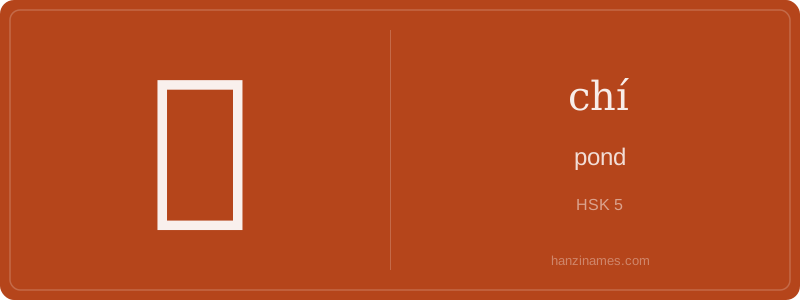
池 (chí) appears widely in modern Chinese place names (e.g., 天池 Tiānchí — 'Heavenly Pond' at Changbai Mountain, a famous volcanic crater lake), classical poetry (Du Fu wrote of lotus ponds), and daily vocabulary like 游泳池 (yóuyǒngchí, swimming pool) and 鱼池 (yúchí, fish pond). It’s also in the idiom 金玉满堂,不如一池春水 (jīnyù mǎn táng, bùrú yī chí chūnshuǐ) — 'Gold and jade fill the hall, yet not equal to one spring pond' — evoking serene beauty over material wealth.
Historically, 池 originated as a pictophonetic character in seal script: the left side clearly represents water (氵), while the right side 也 was borrowed for its sound. No oracle-bone form survives, but bronze inscriptions from the Zhou Dynasty already show early versions used for artificial reservoirs and moats — reflecting its ancient role in water management and defense.
Hi students! Today we’re learning 池 (chí), a Level 5 HSK character meaning 'pond' — a small, still body of water, often man-made and found in gardens, parks, or temples. It’s not a lake (湖 hú) or river (河 hé); it’s calmer, shallower, and more intimate. The left side 氵is the ‘water’ radical — always appearing on the left in characters related to liquids, flow, or moisture. This tells us immediately that 池 is about water.
The right side is 也 (yě), which here serves as a phonetic component — giving a clue to pronunciation (chí sounds somewhat like yě in ancient Chinese). Don’t worry if the sound isn’t exact; many phonetics have shifted over time. What matters is recognizing the pattern: water + sound hint = a water-related word with that pronunciation.
As you practice writing 池 (6 strokes), remember the stroke order: dot, dot, horizontal bend (for 氵), then 也 — starting with the horizontal stroke, followed by the vertical curve, and ending with the final horizontal stroke. Writing slowly and correctly helps your brain link form, sound, and meaning. And yes — this character appears in everyday life far more than you’d think!
Example Sentences
Common Compounds
Similar Characters — Don't Mix These Up
Your First Step into Chinese Culture: Get a Chinese Name
Every journey into Chinese begins with a name. Use our free Chinese name generator to create a meaningful, personalized Chinese name that fits you perfectly.
Get My Chinese Name →