治
Character Story & Explanation
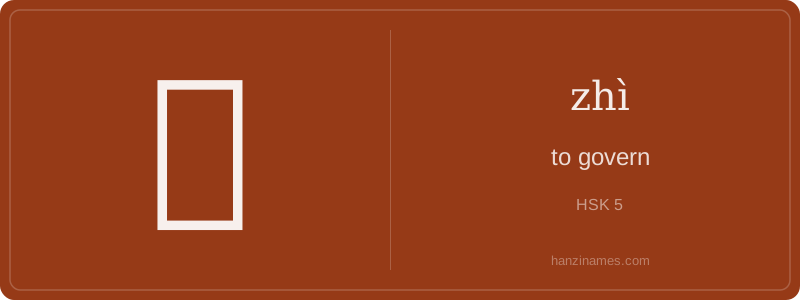
治 is ubiquitous in formal and historical contexts: it appears in classical texts like the *Records of the Grand Historian*, in imperial edicts, and in modern legal-political terms like 依法治国 (governing by law), enshrined in China’s Constitution (2018 amendment). Common idioms include 长治久安 (cháng zhì jiǔ ān, 'lasting stability and enduring peace'), used in official speeches and news headlines since the Han Dynasty.
The character evolved from seal script (c. 3rd c. BCE), where 氵 + 台 (tái, phonetic component, also meaning 'platform' or 'to support') conveyed 'ordering through structured support.' No oracle bone form survives; its earliest attested use is in Warring States bamboo slips. Today, Chinese students write it in HSK 5 textbooks when studying governance vocabulary—and see it daily on government websites and public service announcements.
The character 治 (zhì) embodies a foundational Chinese worldview: governance is not domination, but harmonious cultivation—like tending water. Its radical 氵 (water) signals fluidity, adaptability, and the Daoist ideal of ruling by yielding, as in Laozi’s 'The best rulers are those whose existence is barely known.' In classical thought, 'to rule' meant aligning human order with natural patterns—not imposing will, but channeling energy wisely.
Historically, 治 appears in Confucian texts like the *Analects* and state documents to denote virtuous administration. Unlike Western 'rule' rooted in authority or force, 治 implies moral responsibility: a ruler must first 'govern' themselves (修身治国, xiūshēn zhìguó). This self-cultivation–governance linkage reflects the holistic Confucian belief that ethical integrity flows outward—from person to family to state.
This worldview persists today: modern Chinese political discourse uses 治 to frame governance as systemic stewardship—e.g., 依法治国 (yīfǎ zhìguó, 'governing the nation according to law') evokes balance, procedure, and restraint. Even in medicine (e.g., 治病, zhìbìng, 'to treat illness'), the same logic applies: healing is restoring internal harmony, not merely suppressing symptoms. Thus, 治 reveals a civilization where power is measured by its capacity to nurture, not control.
Example Sentences
Common Compounds
Similar Characters — Don't Mix These Up
Your First Step into Chinese Culture: Get a Chinese Name
Every journey into Chinese begins with a name. Use our free Chinese name generator to create a meaningful, personalized Chinese name that fits you perfectly.
Get My Chinese Name →