漏
Character Story & Explanation
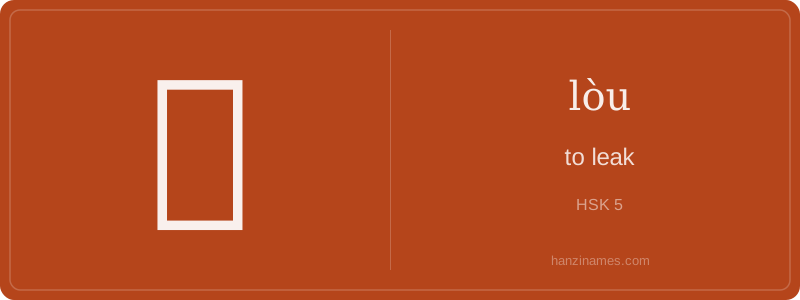
漏 is widely used in modern Chinese for technical and everyday contexts: plumbing repairs (漏水), software bugs ('data leakage'), and administrative errors (漏报, 'underreporting'). It appears in the common idiom 滴水不漏 (dī shuǐ bù lòu, 'not a drop leaks' — meaning 'airtight, flawless'), historically used since at least the Ming dynasty to describe meticulous planning or security. Government reports regularly use 漏登 (lòu dēng, 'omitted registration') when tracking census or vaccine data.
The character evolved from seal script, where 氵+婁 (lóu) formed a phono-semantic compound — 氵 indicating water-related action, and 婁 serving as the phonetic. No oracle-bone form survives, but its structure has remained stable since the Han dynasty. Today, Chinese people commonly say '水管漏了' (the pipe is leaking) during home repairs — a real-life usage heard across cities and villages daily.
Hi students! Today we’re learning 漏 (lòu), a Level 5 HSK character meaning 'to leak' — like water dripping from a cracked pipe or information accidentally escaping. It’s not just about physical leaks; it’s also used for unintentional omissions (e.g., forgetting to include someone in a list) or data breaches. The character has 14 strokes and belongs to the water radical 氵, which tells us its meaning is connected to liquid movement or flow.
Notice how the right side of 漏 is 楼 (lóu, 'building') — but don’t confuse them! This is a phonetic component: 楼 gives the sound clue (lòu is close to lóu), while the left side 氵 confirms the water-related meaning. In spoken Chinese, lòu often appears in verbs like 漏掉 (lòu diào, 'to omit') or 漏水 (lòu shuǐ, 'to leak water'), making it essential for describing errors, accidents, or system failures.
Beginners sometimes mix up 漏 with similar-sounding characters like 露 (lù/lòu, 'to expose') — but remember: 漏 always implies *unintended* loss or escape, never intentional revelation. Think of it as 'slipping through cracks' — whether in pipes, memory, or communication. Practice writing it slowly: start with the three-dot water radical, then build the rest step-by-step using the official stroke order.
Example Sentences
Common Compounds
Similar Characters — Don't Mix These Up
Your First Step into Chinese Culture: Get a Chinese Name
Every journey into Chinese begins with a name. Use our free Chinese name generator to create a meaningful, personalized Chinese name that fits you perfectly.
Get My Chinese Name →