漠
Character Story & Explanation
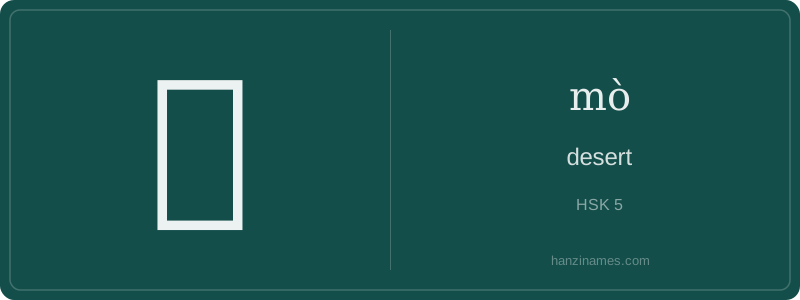
漠 is widely used in modern Chinese to denote both physical deserts (e.g., 沙漠 shāmò, 'sand desert') and figurative emotional distance (e.g., 漠不关心 mò bù guānxīn, 'indifferent'). It appears in official geographic terms like Inner Mongolia’s Kubuqi Desert (库布其沙漠) and in HSK-5 vocabulary lists emphasizing abstract usage. A key idiom is 漠然置之 (mòrán zhì zhī), meaning 'to dismiss with detached indifference,' documented in 20th-century literary criticism and contemporary news reports on social apathy.
The character’s form dates to the seal script (c. 3rd century BCE), where 氵+莫 clearly emerged as a phono-semantic compound: 氵 indicates semantic association with fluidity or terrain (not literal water), while 莫 provides pronunciation and the sense of 'nothingness' or 'boundary.' No oracle-bone inscriptions of 漠 survive; its earliest attested use is in Han dynasty texts referring to frontier deserts.
The character 漠 (mò) embodies a profound duality in the Chinese worldview: it names the vast, arid deserts of northwestern China—like the Taklamakan and Gobi—yet carries connotations far beyond geography. In classical thought, deserts were not merely barren wastelands but liminal spaces: thresholds between civilization and wilderness, life and austerity, human endeavor and cosmic indifference. This reflects the Daoist and Confucian appreciation for emptiness as fertile ground—not of absence, but of potential, stillness, and unspoken depth.
Etymologically, 漠 combines the water radical (氵) with 莫 (mò), meaning 'not' or 'none'—a paradox that reveals deep cultural logic. Though deserts lack surface water, the radical hints at hidden aquifers, ancient oases, or the memory of vanished lakes. Water here symbolizes latent vitality rather than abundance—echoing the philosophical idea that true richness lies in restraint, resilience, and quiet endurance amid scarcity.
This character also anchors abstract emotional states: 漠然 (mòrán) describes detached calm; 漠视 (mòshì) means to ignore indifferently. Such usage reveals how landscape metaphors shape moral cognition in Chinese—desert-like detachment is neither wholly negative nor positive, but contextually ethical: wise reserve versus cold neglect. Thus, 漠 teaches that emptiness, silence, and distance are not voids to be filled, but dimensions of perception to be cultivated.
Example Sentences
Common Compounds
Similar Characters — Don't Mix These Up
Your First Step into Chinese Culture: Get a Chinese Name
Every journey into Chinese begins with a name. Use our free Chinese name generator to create a meaningful, personalized Chinese name that fits you perfectly.
Get My Chinese Name →