睡
Character Story & Explanation
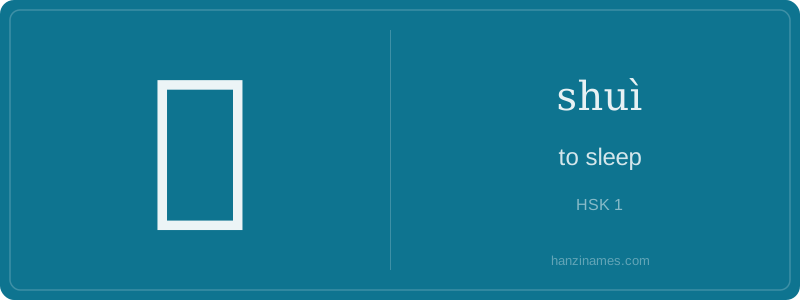
In daily life, 睡 is among the most frequently used verbs for sleep—appearing in commands ('Go to sleep!'), medical contexts ('insomnia'), and even digital slang ('我睡了' meaning 'I’m logging off'). It appears in fixed phrases like 睡觉 (shuìjiào, 'to sleep') and the classical idiom 昏昏欲睡 (hūnhūn yù shuì, 'drowsy, half-asleep'), documented since the Song dynasty in texts like Zhu Xi’s Reflections on Things at Hand.
The character is not pictographic. Its form evolved from seal script: 目 (eye) + 垂 (to droop), first standardized in the Shuōwén Jiězì (121 CE). No oracle-bone or bronze inscriptions bear 睡—it entered writing only after the concept of personal, scheduled rest gained cultural prominence during the Zhou–Warring States transition.
As an archaeologist of script, I brush dust from the oracle-bone fragments—not to find a sleeping figure, but to trace how ancient scribes encoded rest. 睡 (shuì) does not appear in Shang dynasty inscriptions; its earliest secure attestation is in Warring States bamboo texts, where it consistently denotes intentional, bodily repose—never metaphorical or divine slumber. The character’s late emergence reflects how early Chinese writing prioritized ritual, warfare, and agriculture over private physiological states.
The radical 目 (eye) anchors the character’s semantic field: sleep is defined not by unconsciousness alone, but by the closing of the eyes—the most visible, culturally legible sign of rest. The right-hand component 垂 (chuí), meaning 'to hang down' or 'to droop', reinforces this: eyelids sag, head bows, posture surrenders gravity. This is not abstract sleep—it’s embodied, observable, and quietly vulnerable.
Unlike Western concepts that separate mind and body in sleep, 睡 insists on somatic evidence. Its structure encodes a pre-scientific phenomenology: you *know* someone sleeps when their eyes are closed and limbs slacken. No brainwaves needed—just the drooping eyelid, captured in ink over two millennia ago. That gaze-turned-inward remains central to how Mandarin speakers conceptualize rest today: sleep is an act of withdrawal, witnessed and named through the body’s quietest gestures.
Example Sentences
Common Compounds
Similar Characters — Don't Mix These Up
Your First Step into Chinese Culture: Get a Chinese Name
Every journey into Chinese begins with a name. Use our free Chinese name generator to create a meaningful, personalized Chinese name that fits you perfectly.
Get My Chinese Name →