湿
Character Story & Explanation
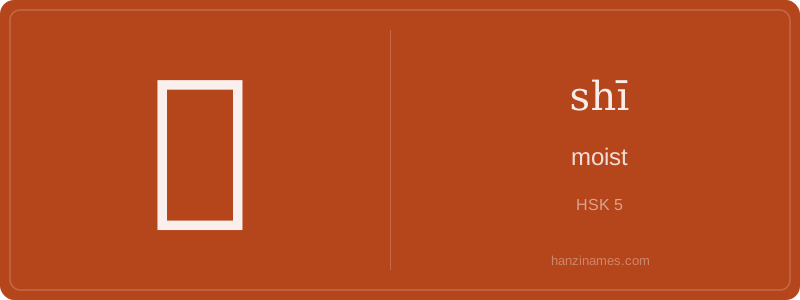
In daily life, 湿 is indispensable in weather reports (‘湿度’ — humidity), home maintenance (‘潮湿的地下室’ — damp basement), and TCM diagnosis (e.g., ‘湿气重’ — excessive internal dampness). It appears in the widely used phrase 湿疹 (shīzhěn, eczema), documented in Ming-dynasty medical compendia like Compendium of Materia Medica (Bencao Gangmu). Modern speakers also use it colloquially: ‘衣服还没干,太湿了’ (Clothes aren’t dry yet — too damp!).
The character’s form has no oracle-bone origins — it first appears reliably in Warring States bamboo slips (475–221 BCE) as a variant of 濕, later simplified to 湿 in 1956’s PRC character reform. Its right side 显 was chosen for phonetic approximation, not visual symbolism — a pragmatic scribal decision, not a pictorial one.
Our detective work begins at the crime scene: the character 湿. At first glance, it’s a classic left–right structure — water on the left (氵), meaning tied to liquid or moisture; the right side, 显 (xiǎn), was historically a phonetic component hinting at pronunciation (though modern shī diverges slightly from xiǎn’s sound). This is a phono-semantic compound — one of the most common types in Chinese script — where form and function collaborate like seasoned investigators.
Zooming in on the radical: 氵, the ‘three-dot water’ radical, appears in over 400 characters related to liquids — from river (河) to sweat (汗) to flood (洪). Its presence here isn’t poetic suggestion — it’s forensic evidence confirming 湿 belongs squarely in the domain of water-based states. No ambiguity: this character deals with dampness, not dry heat or vapor alone.
Tracing its evolution through seal script (c. 221 BCE) and clerical script (Han dynasty), we find 湿 consistently retaining both its semantic anchor (water) and phonetic scaffold. Unlike characters that morphed beyond recognition, 湿 stayed remarkably stable — a testament to its functional clarity. By the Tang dynasty, it was already standard in medical texts describing ‘dampness’ as a pathogenic factor in Traditional Chinese Medicine — making it not just linguistic evidence, but clinical documentation.
Example Sentences
Common Compounds
Similar Characters — Don't Mix These Up
Your First Step into Chinese Culture: Get a Chinese Name
Every journey into Chinese begins with a name. Use our free Chinese name generator to create a meaningful, personalized Chinese name that fits you perfectly.
Get My Chinese Name →