浏
Character Story & Explanation
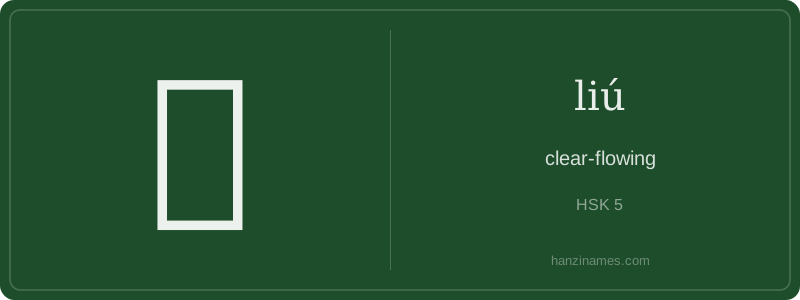
Today, 浏 is rarely used independently in speech or writing. Its primary real-world appearance is in the proper noun 浏阳 (Liúyáng), a county-level city in Hunan Province—famous as the hometown of Mao Zedong and a historic center for fireworks production since the Tang Dynasty. The name likely reflects the area’s clear-flowing rivers, consistent with the character’s classical sense of 'unobstructed water movement'. It also appears in literary or poetic contexts, especially in the reduplicated form 浏浏, as in classical allusions or formal essays.
The character’s written form has no verified pictographic origin—it emerged later as a phono-semantic compound during the Warring States or early Han period. There are no oracle bone or bronze inscriptions for 浏. Instead, Chinese learners most commonly encounter it today in geography (e.g., 浏阳河 Liúyáng Hé, the ‘Liu Yang River’ celebrated in the folk song ‘The Liu Yang River’), making place names its dominant living context.
As a linguistic detective, I begin with the radical: 氵—three dots representing water, a telltale sign this character is hydrologically rooted. Though modern dictionaries list 'clear' as its basic meaning, that gloss is deceptively narrow. In classical usage, 浏 rarely stands alone with an adjectival sense; instead, it appears almost exclusively in reduplicated form—浏浏—as an onomatopoeic or descriptive adverb evoking smooth, unobstructed flow: of water, light, or even thought. Its semantic core is *unimpeded movement*, not visual transparency.
Tracing its earliest attestation, 浏 appears in the *Chu Ci* (Songs of Chu), c. 3rd century BCE, where 浏浏 describes wind or water moving freely—'gushing', 'rippling', 'gliding'. Unlike characters like 清 (qīng, 'clear/clean'), which emphasize purity or absence of impurity, 浏 emphasizes dynamic clarity: clarity achieved through motion and continuity. It’s less about stillness and more about lucid momentum—like sunlight streaming through moving water.
The character’s structure reveals its logic: left side 氵 (water) + right side 刘 (liú, phonetic component, also a common surname). This is a classic形声字 (xíngshēngzì)—a phono-semantic compound. The phonetic 刘 gives pronunciation but carries no semantic weight here; the water radical anchors its domain. Interestingly, 刘 itself originally meant 'to kill' (in oracle bone script), but that meaning was entirely eclipsed by its phonetic role in 浏. No trace of violence remains—only fluidity.
Example Sentences
Common Compounds
Similar Characters — Don't Mix These Up
Your First Step into Chinese Culture: Get a Chinese Name
Every journey into Chinese begins with a name. Use our free Chinese name generator to create a meaningful, personalized Chinese name that fits you perfectly.
Get My Chinese Name →