习
Character Story & Explanation
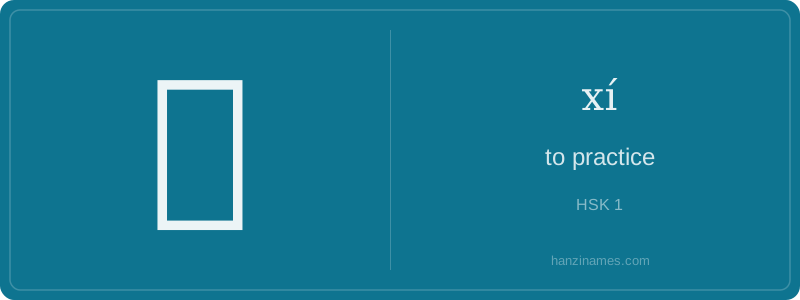
In daily life, 习 is foundational: children say ‘wǒ zài xí zuòyè’ (I’m practicing homework); musicians ‘xí qín’ (practice the instrument); and learners memorize the idiom ‘xí yǐ wéi cháng’ (to practice until it becomes habitual). Historically, it appears in the earliest standardized dictionaries like the Shuōwén Jiězì (121 CE), defined as ‘repeatedly performing to become familiar’. It’s central to Confucian self-cultivation and modern HSK curricula alike.
The character’s form is *not* derived from oracle bone script (no verified early form exists), but its current structure—冫+乛+一—is documented since the Warring States period. Today, Chinese students write it first when learning stroke order principles: dot, then left-falling stroke, then horizontal—embodying ‘start small, stay steady, finish clean’.
As an archaeologist brushing dust from a Han dynasty bamboo slip, I find 习 inscribed in clear clerical script—not as a frozen relic, but as a living trace of pedagogy. Its three strokes—two icy 'ice' radicals (冫) and a final horizontal sweep—suggest early scribes saw practice as something cold, deliberate, and sharpening: like honing a blade on stone. This isn’t mere repetition; it’s disciplined refinement, echoing Confucius’ emphasis on ‘learning and regularly practicing what is learned’ (Xue Er, Analects 1.1).
The radical 冫 (bīng), meaning ‘ice’, appears unexpectedly here—yet historically, it conveys crispness, clarity, and controlled effort. Unlike warm, spontaneous action, 习 implies intentionality: the chill of focus before mastery. In excavated school texts from Dunhuang, students copied 习 hundreds of times—not as rote drill, but as ritual calibration of hand, eye, and mind. Each stroke was a vow to internalize knowledge through embodied repetition.
Modern paleography confirms 习 evolved from a pictograph of a bird learning to fly—wings flapping repeatedly—later stylized into its current form. Though the bird imagery faded by the Qin seal script, the semantic core endured: iterative motion toward competence. When we write 习 today, we’re not just forming characters—we’re enacting a 2,500-year-old covenant between effort and excellence, one deliberate stroke at a time.
Example Sentences
Common Compounds
Similar Characters — Don't Mix These Up
Your First Step into Chinese Culture: Get a Chinese Name
Every journey into Chinese begins with a name. Use our free Chinese name generator to create a meaningful, personalized Chinese name that fits you perfectly.
Get My Chinese Name →