米
Character Story & Explanation
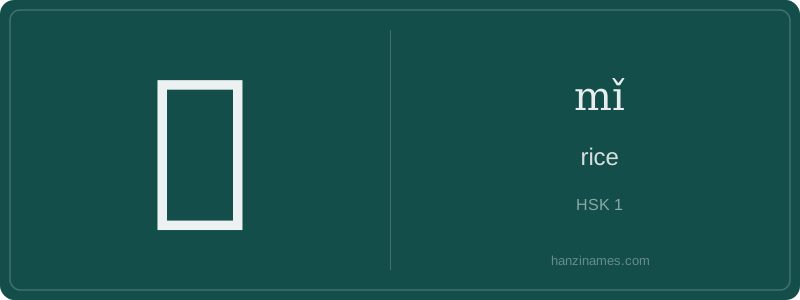
In daily life, 米 is indispensable: families buy it by the jin (catty) at wet markets, cook it in electric rice cookers (电饭煲, diànfànbāo), and refer to meals with phrases like ‘有米下锅’ (yǒu mǐ xià guō, ‘rice is in the pot’ — meaning resources are available). It appears in idioms like ‘鱼米之乡’ (yú mǐ zhī xiāng, ‘land of fish and rice’), describing fertile southern regions like Jiangsu and Zhejiang — historically documented as China’s rice baskets since the Tang Dynasty.
The character 米 is a stylized pictograph: oracle bone and bronze inscriptions (c. 1200 BCE) show grains radiating from a central stalk — clearly depicting rice plants with drooping panicles. By the Small Seal Script (Qin Dynasty), it simplified into today’s six-stroke form, preserving the essence of scattered grains — a rare case where the modern glyph retains strong visual fidelity to its agricultural origin.
The character 米 (mǐ) is a foundational HSK Level 1 character representing uncooked rice — the staple grain that has sustained Chinese civilization for over 7,000 years. Its six-stroke structure is clean and symmetrical, reflecting its ancient role as both food and measure. As a radical, 米 appears in dozens of characters related to grains, food, and measurement (e.g., 粮 ‘grain’, 粉 ‘flour’), anchoring vocabulary in daily life and agriculture.
Historically, rice cultivation began in the Yangtze River Valley around 5000 BCE, and 米 became central to China’s economy, taxation, and social structure. In imperial times, salaries were often paid in *shí* (石, a unit of rice), and the phrase ‘a bowl of rice’ (一碗饭) remains synonymous with basic sustenance. This deep cultural entrenchment makes 米 far more than a word — it’s a symbol of nourishment, livelihood, and continuity.
Modern usage extends beyond literal rice: 米 appears in loanwords like 咖啡米 (kāfēi mǐ, ‘coffee beans’) and tech slang like ‘米粉’ (mǐfěn, ‘Mi Fan’ — fans of Xiaomi, whose logo resembles 米). Even the unit ‘meter’ is written as 米 in Chinese (borrowed via Japanese), showing how this humble grain-character evolved into a universal measure — a linguistic testament to rice’s enduring influence on language, identity, and science.
Example Sentences
Common Compounds
Similar Characters — Don't Mix These Up
Your First Step into Chinese Culture: Get a Chinese Name
Every journey into Chinese begins with a name. Use our free Chinese name generator to create a meaningful, personalized Chinese name that fits you perfectly.
Get My Chinese Name →