玉
Character Story & Explanation
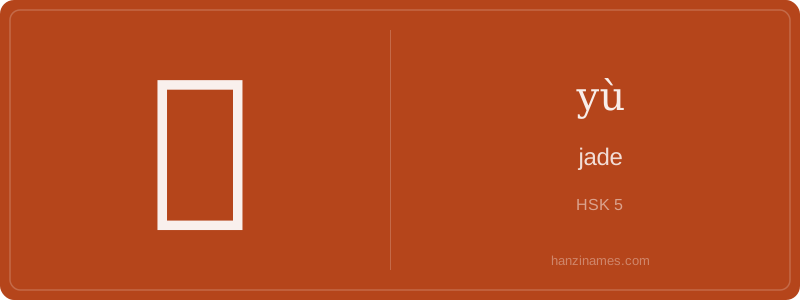
In daily life, 玉 appears in names (e.g., Yùméi, ‘Jade Plum’), jewelry labels (‘A-grade jade’), and idioms like 宁为玉碎,不为瓦全 (nìng wéi yù suì, bù wéi wǎ quán)—‘Better to shatter like jade than survive as broken tile,’ expressing moral integrity. Historically, jade bi discs and cong tubes were buried with elites; the Mawangdui Han tombs (2nd c. BCE) contained over 40 jade pieces per corpse to preserve the body and soul.
The earliest attested form of 玉 (late Shang oracle bones) depicts three parallel jade slabs tied by a cord—a clear pictograph. Bronze inscriptions retain this structure, confirming its origin as a stylized representation of ritual jade objects, not an abstract symbol. No scholarly source reconstructs it as a ‘king with dots’—that interpretation arose later, after the character had already diverged from 王.
Our investigation begins with the oracle bone and bronze inscriptions of the Shang and Zhou dynasties—where 玉 first appears not as a standalone pictograph, but as a simplified variant of 王 (wáng, 'king'), distinguished by three horizontal strokes and a dot or short line. Early forms often resembled a string of jade beads tied together, reflecting jade’s ritual use in elite burials and ancestral ceremonies. Archaeological evidence from Liangzhu culture (3300–2300 BCE) confirms jade’s sacred status long before standardized writing emerged.
The character stabilized during the Qin dynasty’s script unification, when clerical script (lìshū) formalized its five-stroke structure: a dot (丶), then three horizontal strokes (一), and a final descending stroke (丿). Crucially, the top dot differentiates it from 王—making 玉 literally 'jade-king', a visual pun underscoring jade’s symbolic sovereignty in Chinese cosmology. This distinction was codified in the Shuōwén Jiězì (121 CE), China’s first dictionary, which defines 玉 as 'beauty stone' with moral resonance.
Unlike purely phonetic characters, 玉 functions both semantically and phonetically: it serves as the radical for over 500 jade-related characters (e.g., 珍, 理, 瑞), and its pronunciation yù is borrowed in phonetic components (e.g., 誉 yù ‘praise’, 域 yù ‘region’). Its semantic weight extends beyond mineralogy—it embodies purity, virtue, and incorruptibility in Confucian thought, where ‘gentlemen compare virtue to jade’ (Analects 17.12). Thus, 玉 is less a lexical unit than a cultural cipher.
Example Sentences
Common Compounds
Similar Characters — Don't Mix These Up
Your First Step into Chinese Culture: Get a Chinese Name
Every journey into Chinese begins with a name. Use our free Chinese name generator to create a meaningful, personalized Chinese name that fits you perfectly.
Get My Chinese Name →