皂
Character Story & Explanation
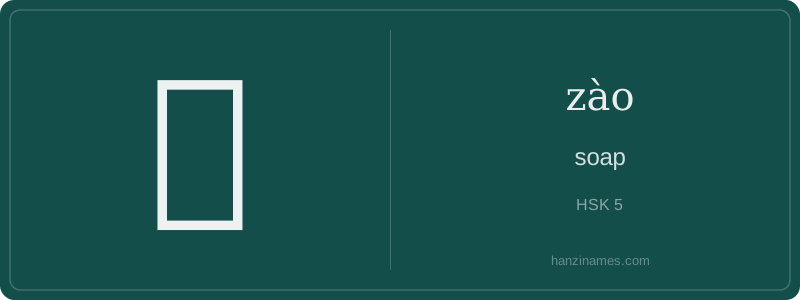
In daily life, 皂 is rarely used alone—modern Mandarin almost always pairs it with 肥 (féi) as 肥皂 (féizào, 'soap'). It appears in pharmacy labels, traditional herbal formulas (e.g., 皂角刺 zàojiǎo cì, Gleditsia thorn used in TCM), and historical texts like the Ming-era Compendium of Materia Medica (Bencao Gangmu), which documents 皂荚 (zàojiá, soap pod) as a cleansing and expectorant agent.
The character’s form is not pictographic but phono-semantic: 白 (bái, 'white') is the semantic radical indicating purity/whiteness; 七 (qī, 'seven') was historically the phonetic component (though pronunciation diverged). Its seven-stroke structure stabilized during the Han dynasty clerical script—no oracle-bone or bronze inscriptions exist for 皂, confirming its later lexical emergence tied to material culture, not cosmology.
The character 皂 (zào) embodies a quiet cultural pivot: from ancient ritual purity to modern hygiene, it reflects how the Chinese worldview links cleanliness with moral and social order. Historically, 'soap' wasn’t just a commodity—it was tied to rites of passage, temple ablutions, and Confucian ideals of self-cultivation through bodily discipline. Its radical 白 (bái, 'white') signals not just color but symbolic clarity—purity unclouded by impurity or deceit.
Unlike Western soap’s industrial origins, 皂 entered Chinese life via plant-based lye-soap (e.g., from soapberry fruit, 肥皂树), long before alkali synthesis. This botanical root echoes Daoist harmony with nature: cleansing without violence to skin or soil. The character thus carries ecological mindfulness—a reminder that care for the self is inseparable from care for the world.
Today, 皂 appears in compounds like 肥皂 (féizào, 'soap') and 皂角 (zàojiǎo, soapnut), preserving lexical memory of pre-modern sustainability. Even as synthetic detergents dominate, the character endures in branding, literature, and medicine—signaling authenticity, gentleness, and tradition. In this way, 皂 is more than a noun; it’s a grammatical vessel for centuries of embodied ethics.
Example Sentences
Common Compounds
Similar Characters — Don't Mix These Up
Your First Step into Chinese Culture: Get a Chinese Name
Every journey into Chinese begins with a name. Use our free Chinese name generator to create a meaningful, personalized Chinese name that fits you perfectly.
Get My Chinese Name →