睁
Character Story & Explanation
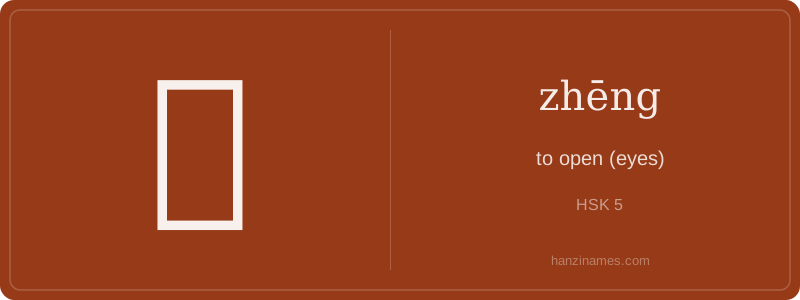
睁 is widely used in modern Chinese to express awakening — both literal and metaphorical. It appears in common phrases like 睁开眼睛 (zhēng kāi yǎn jīng, 'to open one’s eyes') and idioms like 睁一只眼闭一只眼 (zhēng yī zhī yǎn bì yī zhī yǎn, 'to turn a blind eye'). It’s frequent in journalism and education contexts discussing social awareness — e.g., '睁眼看世界' ('open your eyes to see the world'), a phrase popularized in late Qing reformist writings urging China to learn from the West.
The character is not pictographic but phono-semantic: the left part 目 clearly represents 'eye', while the right part 争 (zhēng) provides the pronunciation and hints at effort or urgency. No oracle bone or bronze script form survives for 睁 — it first appeared in seal script during the Qin dynasty (3rd c. BCE) as a newly coined character for intentional eye-opening, reflecting evolving linguistic needs in classical texts.
Hi students! Let’s look at the character 睁 (zhēng). It means 'to open' — especially 'to open one’s eyes'. Notice its radical 目 (mù), which means 'eye' — that’s your first clue! This character is not about opening doors or boxes; it’s specifically about opening the eyes, either literally (waking up) or figuratively (becoming aware). It’s a vivid, physical verb that appears often in descriptive writing and emotional expressions.
The pronunciation zhēng is a first-tone word, so keep your voice level and clear — like saying 'jung' with a flat, high pitch. Since it’s HSK Level 5, you’ll encounter it in more advanced reading, such as news articles about social awakening or literary passages describing characters’ reactions. Don’t confuse it with general 'open' verbs like 开 (kāi); 睁 always involves eyes.
It has 11 strokes — let’s break them down: start with the left 'eye' radical (目: 5 strokes), then add the right side ‘争’ (zhēng, meaning 'to compete'), which contributes both sound and subtle nuance — as if 'opening the eyes' is an active, even urgent act of engagement with reality. That’s why it feels stronger than just 'blink' or 'look' — it implies intention and awareness.
Example Sentences
Common Compounds
Similar Characters — Don't Mix These Up
Your First Step into Chinese Culture: Get a Chinese Name
Every journey into Chinese begins with a name. Use our free Chinese name generator to create a meaningful, personalized Chinese name that fits you perfectly.
Get My Chinese Name →