矛
Character Story & Explanation
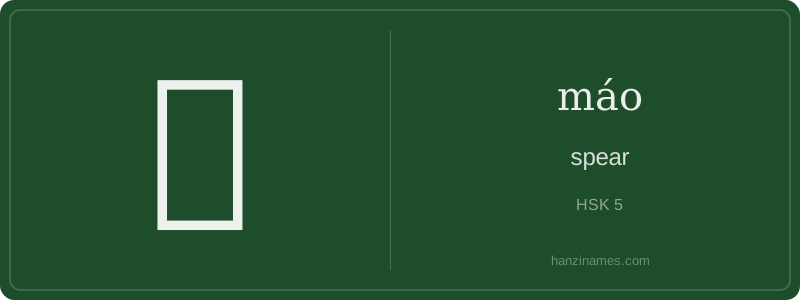
The character 矛 appears today almost exclusively in classical compounds and idioms—not in daily speech about modern weapons. Its most vital usage is in the idiom 自相矛盾 (zì xiāng máo dùn), 'self-contradictory,' derived from a Han dynasty parable about a vendor who claimed his spear could pierce any shield—and his shield could block any spear. This phrase remains standard in HSK 5+ textbooks, news commentary, and logic education across China.
Archaeologically, 矛 is a confirmed pictograph: bronze inscriptions (c. 1000 BCE) clearly depict a spearhead with central blade and lateral flanges—matching excavated Shang and Zhou spears. The modern shape preserves this structure: the dot (丶) is the tip, the horizontal (一) the shaft, and the two curved strokes (厶) the side guards—verified by comparative epigraphy and artifact typology.
As an archaeologist brushing dust from a Warring States bronze spearhead unearthed near Luoyang, I see the character 矛 not as ink on paper—but as cold bronze gleaming in torchlight. Its five strokes reconstruct the weapon’s essential anatomy: the pointed tip (丶), the slender shaft (一), and the two downward-curving guard blades (厶) flanking it—captured with astonishing fidelity in early seal script. This isn’t abstraction; it’s metallurgical documentation.
Excavations at Yin Xu confirm that by the late Shang dynasty, 矛 was already standardized in oracle bone inscriptions—not as a pictogram of war, but as a tax record: '30 spears delivered to the royal armory.' The character’s stability across 3,200 years reflects its functional primacy: unlike swords or bows, the spear was the infantryman’s universal tool—measured, rationed, and archived. Its radical *is* itself—a rare self-referential radical denoting both form and function.
Modern linguistic analysis reveals something subtle: 矛 never evolved into a verb meaning 'to spear'—unlike English 'to spear'—because in Classical Chinese, weapons were nouns of state, not action. Instead, it fused semantically with 盾 (shield) to birth the foundational paradox of Chinese strategic thought: 矛盾 (máodùn), 'spear-and-shield,' later abstracted by Han Feizi into 'contradiction.' Thus, 矛 anchors not just military history—but logic itself.
Example Sentences
Common Compounds
Similar Characters — Don't Mix These Up
Your First Step into Chinese Culture: Get a Chinese Name
Every journey into Chinese begins with a name. Use our free Chinese name generator to create a meaningful, personalized Chinese name that fits you perfectly.
Get My Chinese Name →