矩
Character Story & Explanation
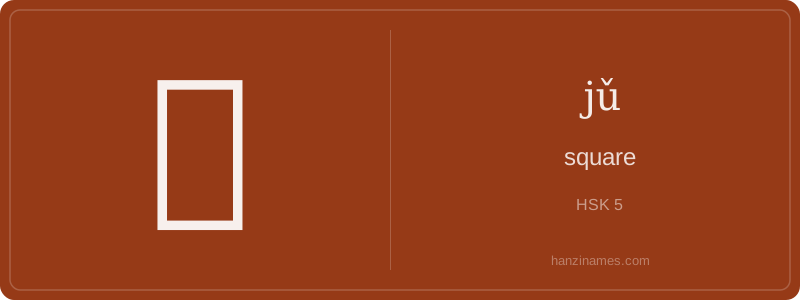
矩 appears in foundational idioms like 循规蹈矩 (xún guī dǎo jǔ), meaning 'to follow rules rigidly'—originating from Song-dynasty Neo-Confucian discourse on ritual propriety and later acquiring both neutral and pejorative connotations depending on context. It’s also central in classical mathematics: the Nine Chapters on the Mathematical Art (c. 100 BCE–50 CE) uses 矩 to describe right-angle measurement in land surveying and construction. Today, it’s indispensable in STEM education as the core character in 矩阵 (jùzhèn, 'matrix'), taught across HSK 5+ curricula and university engineering programs.
The character’s form evolved from seal script, where 矩 combined 矢 (arrow, suggesting direction/precision) and 巨 (jù, 'great', acting phonetically). While not a pictograph, its structure reflects functional logic: the arrow radical signals purposeful measurement, and the phonetic component anchors pronunciation—demonstrating how Chinese characters encode both sound and semantic intent through systematic composition.
The character 矩 (jǔ) embodies a profound convergence of craftsmanship and moral philosophy in Chinese thought. Literally a carpenter’s square—a tool for drawing precise right angles—it symbolizes unwavering standards, fairness, and ethical boundaries. In classical texts like the Great Learning, 'rectifying the square' (正矩) metaphorically means aligning one’s conduct with universal principles—suggesting that moral integrity, like geometry, requires rigor and consistency.
This tool transcends its utilitarian origin: Confucian scholars likened the square to the ‘rules of propriety’ (礼), while Daoist and Legalist thinkers invoked it to stress impartiality in governance. The square does not bend; neither should justice or self-cultivation. Thus, 矩 is not merely a measuring device but a cultural shorthand for disciplined adherence to truth, harmony, and social order.
In modern usage, 矩 retains this dual resonance—appearing in technical terms like 'matrix' (矩阵) while still echoing in idioms about moral rectitude. Its radical 矢 (arrow) hints at directionality and precision, reinforcing the idea that ethical life, like an arrow aimed true, must follow clear, unyielding lines. This reflects the Chinese worldview where material objects, language, and virtue are interwoven—not separate domains, but expressions of the same cosmic coherence.
Example Sentences
Common Compounds
Similar Characters — Don't Mix These Up
Your First Step into Chinese Culture: Get a Chinese Name
Every journey into Chinese begins with a name. Use our free Chinese name generator to create a meaningful, personalized Chinese name that fits you perfectly.
Get My Chinese Name →