硬
Character Story & Explanation
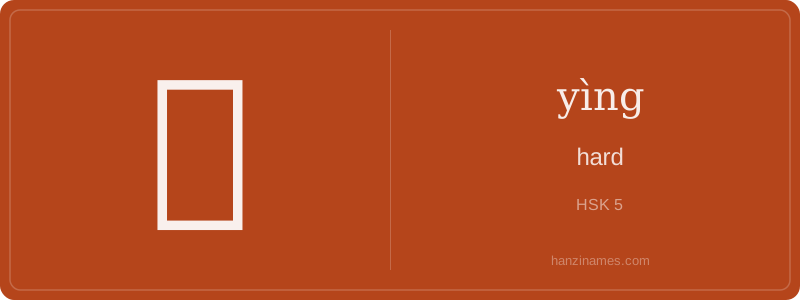
In daily life, 硬 is ubiquitous: food packaging labels say ‘硬糖’ (yìng táng, ‘hard candy’); subway announcements warn ‘请握紧扶手,列车即将启动,车厢较硬’ (‘Hold the handrail—the train is starting; the ride may be stiff’); and in tech slang, ‘硬核’ (yìng hé, ‘hard-core’) describes demanding games or deep technical content. A documented idiom is ‘硬着头皮’ (yìng zhe tóu pí)—literally ‘hardening one’s scalp’—meaning to face something unpleasant with forced courage, attested in Qing-era vernacular fiction and still used in news reports and workplace speech.
The character is not pictographic—it has no oracle bone or bronze script precursor depicting hardness directly. Instead, it emerged fully formed in seal script (c. 3rd century BCE) as a phonosemantic compound. Its enduring shape reflects functional design: the stone radical grounds meaning, while 更’s angular strokes convey structural firmness—making the written form itself feel ‘hard’ to write quickly, reinforcing its semantic weight.
As a linguistic detective, I begin with the radical: 石 (shí), meaning 'stone'—a concrete, unyielding element that anchors 硬’s semantic core. This radical appears on the left, signaling that the character belongs to the domain of physical substance and material properties. The right side, 更 (gēng), originally meant 'to change' or 'to replace', but here functions phonetically—its Middle Chinese pronunciation *kæŋ* closely approximates modern yìng. This is a classic xíngshēng (phonosemantic) compound: meaning from stone, sound from 更.
The character first appears in standardized form in the Han dynasty’s *Shuōwén Jiězì* (c. 100 CE), where it’s defined as ‘堅也’ (jiān yě)—‘firm, solid’—confirming its early association with resistance to deformation. Unlike pictographs, 硬 wasn’t drawn from observation of objects but constructed logically: hardness is what stone embodies, and 更 provides the vocal key. Its 12-stroke composition reflects careful balance—five strokes for 石, seven for 更—ensuring visual stability mirroring its semantic weight.
Over centuries, 硬 expanded beyond physical rigidity into metaphorical domains: ‘hard’ decisions, ‘stiff’ attitudes, ‘uncompromising’ principles. In Tang poetry and Ming legal texts, it described both unyielding metal and inflexible moral stances. Modern usage retains this duality: it can praise resilience (硬汉, yìng hàn, ‘tough man’) or criticize rigidity (太硬, tài yìng, ‘too stiff’). Its HSK 5 status reflects this semantic richness—not just a simple adjective, but a cultural lens on strength, resistance, and boundary.
Example Sentences
Common Compounds
Similar Characters — Don't Mix These Up
Your First Step into Chinese Culture: Get a Chinese Name
Every journey into Chinese begins with a name. Use our free Chinese name generator to create a meaningful, personalized Chinese name that fits you perfectly.
Get My Chinese Name →