神
Character Story & Explanation
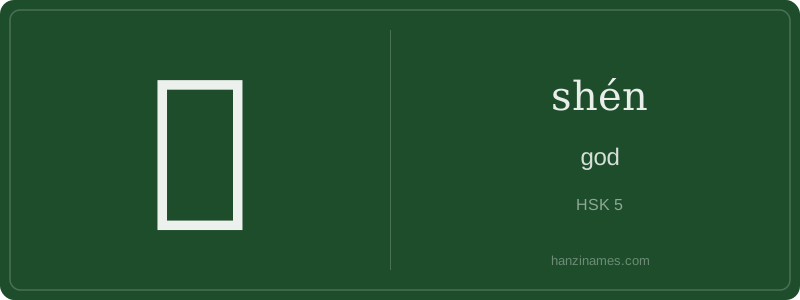
神 appears over 2,000 times in the Records of the Grand Historian (Shǐjì, c. 94 BCE), consistently denoting ancestral spirits, nature deities, and imperial legitimacy through divine mandate. Today, it’s central in common idioms like shén tōng guǎng dà (‘divine powers vast and great’) — used humorously for someone exceptionally skilled — and in compound words like shén shè (‘shrine’), still visible in temples across China and Taiwan. It’s also key in Traditional Chinese Medicine terms such as shén zhì (‘spirit-mind’), reflecting holistic health concepts.
The character evolved from bronze inscriptions where 礻 was clearly an altar and 申 represented lightning or cosmic extension — confirmed by scholars like Li Xiaoding (1985) in Oracle Bone Script Dictionary. This visual origin reflects ancient beliefs linking divine authority with natural forces like thunder and celestial order.
Hi students! Let’s explore 神 (shén) — a foundational character at HSK Level 5. Though often translated as 'God', it carries much richer meaning: it refers to deities, spirits, divine power, and also the intangible 'vital essence' or 'spirit' in traditional Chinese medicine and philosophy. It’s not just about religion — you’ll hear it in phrases like 'shén qì' (vital energy) or 'shén jīng' (nerves). Understanding 神 helps unlock deeper layers of Chinese thought, from Daoist cosmology to everyday expressions of awe.
The left side 礻 (the ‘altar’ or ‘ritual’ radical) signals its connection to worship and the sacred — this same radical appears in characters like 祝 (to pray) and 福 (blessing). The right side 申 (shēn) originally depicted lightning or a stretching force — symbolizing divine power descending or manifesting. Together, they suggest a sacred presence that is both transcendent and active in the world.
Don’t confuse 神 with mere superstition! In modern usage, it’s deeply embedded in language: 'shén mì' means 'mysterious', 'shén qí' means 'magical', and even 'shén le' (‘it’s gone!’) is slang for something vanishing instantly — showing how the idea of ‘supernatural swiftness’ has entered colloquial speech. This flexibility makes 神 one of the most culturally resonant characters you’ll learn.
Example Sentences
Common Compounds
Similar Characters — Don't Mix These Up
Your First Step into Chinese Culture: Get a Chinese Name
Every journey into Chinese begins with a name. Use our free Chinese name generator to create a meaningful, personalized Chinese name that fits you perfectly.
Get My Chinese Name →