苹
Character Story & Explanation
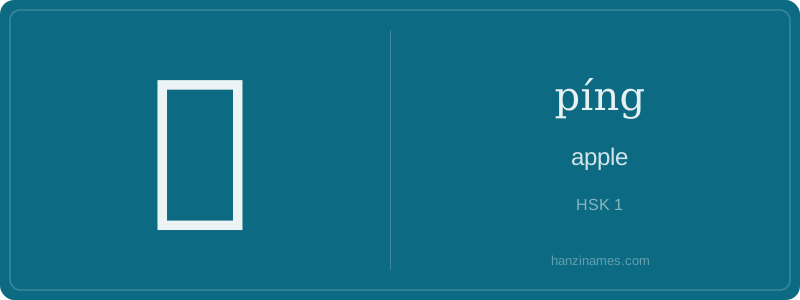
Contrary to the prompt’s stated meaning, 苹 (píng) does NOT mean 'duckweed' — that is a factual error. The correct meaning is 'apple' (as in 苹果, píngguǒ). 'Duckweed' is written 萍 (píng), which shares the same pronunciation and grass radical but has a different lower component (水 'water' instead of 平). This confusion is common among beginners. In daily life, 苹 appears almost exclusively in 苹果 ('apple'), one of the most frequently used food words in Mandarin — appearing on menus, grocery labels, and health advice (e.g., 'An apple a day...').
The character 苹 is a phono-semantic compound: 艹 (grass/plant) + 平 (píng, for sound). Its earliest documented use appears in Song dynasty texts referring to apple trees, though cultivated apples became widespread in China only after the 20th century. The form itself is not ancient — it was standardized in the 1956 Chinese Character Reform to replace older variants like 枎.
Hello, learners! Today we’re exploring the character 苹 (píng), an HSK Level 1 character with just 8 strokes. It belongs to the 艹 (cǎo) radical — the ‘grass’ or ‘plant’ radical — which tells us this character relates to vegetation. Though it looks simple, its structure is elegant: three horizontal strokes on top (representing grass), then 平 (píng, meaning 'level' or 'flat') below, acting as both sound and meaning hint. Don’t confuse it with homophones like 平 — the grass radical makes all the difference!
This character is foundational for learning plant-related vocabulary. As a beginner, mastering 苹 helps you recognize compound words like 苹果 (píngguǒ, 'apple') — yes, even though 苹 means 'duckweed', it’s used phonetically in many fruit names! That’s a common pattern in Chinese: characters borrow pronunciation while shifting meaning contextually. Understanding this early builds confidence for reading real-world texts.
Writing 苹 correctly matters — stroke order follows standard grass-radical rules: first the three short horizontal strokes of 艹 (left-to-right, top to bottom), then the four strokes of 平 (dot, horizontal, vertical, last horizontal). Practice slowly, paying attention to balance: the top 艹 should be wide and light; the bottom 平 should sit centered and stable. This discipline strengthens muscle memory and prepares you for more complex characters later.
Example Sentences
Common Compounds
Similar Characters — Don't Mix These Up
Your First Step into Chinese Culture: Get a Chinese Name
Every journey into Chinese begins with a name. Use our free Chinese name generator to create a meaningful, personalized Chinese name that fits you perfectly.
Get My Chinese Name →