茶
Character Story & Explanation
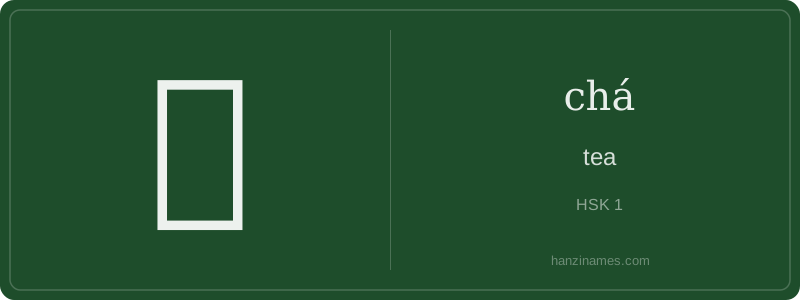
茶 is deeply embedded in daily Chinese life: offered to guests as a sign of respect, served at family meals, and central to social rituals like weddings and business meetings. Historically, it appears in Tang-era texts like Lu Yu’s *Chá Jīng* (The Classic of Tea), the world’s first monograph on tea culture. Common phrases include ‘请喝茶’ (qǐng hē chá, 'Please have some tea') and idioms like ‘茶饭不思’ (chá fàn bù sī, 'so preoccupied one forgets tea and food').
The character evolved from the ancient form 荼 (tú), used for bitter herbs including early tea. By the Tang dynasty, 茶 was standardized with the 艹 radical and 余 phonetic—documented in dictionaries like *Kāngxī Zìdiǎn*. It is not pictographic but phono-semantic: the grass radical indicates plant origin; 余 hints at pronunciation in Middle Chinese.
Our detective work begins with the radical 艹—'grass' or 'plant'—sitting atop the character like botanical evidence. This top component immediately signals that 茶 is a plant-derived substance, anchoring it in the natural world. Below it, the phonetic component 余 (yú) once approximated the ancient pronunciation, though modern chá has drifted phonetically—yet the visual structure preserves this historical clue like a linguistic fingerprint.
Zooming in on the nine strokes, we see meticulous craftsmanship: three horizontal grass strokes (艹), followed by a dot, a vertical stroke, a curved hook, and two final horizontal sweeps. Each stroke follows strict order—no shortcuts allowed—mirroring tea’s own preparation ritual: precise, patient, intentional. The stroke count isn’t arbitrary; it reflects the character’s balanced composition, where meaning and sound coalesce in disciplined form.
This character doesn’t just name a drink—it encodes millennia of cultural weight. From Tang dynasty tea ceremonies codified by Lu Yu in *The Classic of Tea* (760 CE) to today’s ubiquitous bubble tea shops, 茶 is a living artifact. Its simplicity belies deep resonance: a single character bridges agrarian roots, scholarly refinement, and global commodity trade—proving that even the smallest glyph can hold an empire of meaning in its nine strokes.
Example Sentences
Common Compounds
Similar Characters — Don't Mix These Up
Your First Step into Chinese Culture: Get a Chinese Name
Every journey into Chinese begins with a name. Use our free Chinese name generator to create a meaningful, personalized Chinese name that fits you perfectly.
Get My Chinese Name →