称
Character Story & Explanation
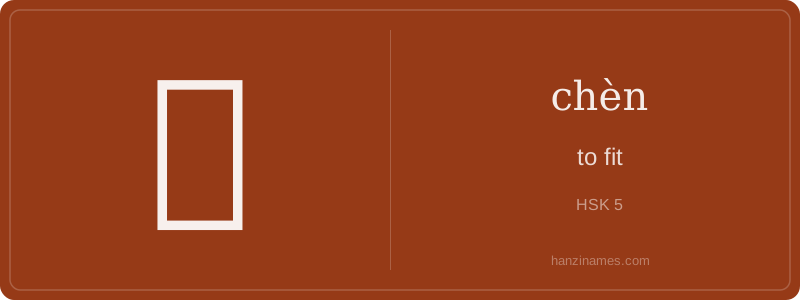
称 (chèn) appears frequently in classical and modern Chinese in contexts demanding evaluative harmony — especially in formal address, moral assessment, and technical precision. A well-documented idiom is 相称 (xiāngchèn), meaning 'mutually fitting', used since at least the Tang dynasty in literary criticism and etiquette manuals to describe balanced relationships between title and conduct, appearance and substance, or gift and status. In modern usage, it’s essential in education (e.g., 称职 teachers — 'competent/suitable teachers') and official documents (e.g., 职称 — 'professional title').
The character’s form combines 禾 (grain/rice plant, radical #115, symbolizing growth and sustenance) with 尔 (ěr, originally a phonetic component, later simplified from 爾). While not pictographic, its structure reflects historical association with measurement and fairness — grain was weighed and assessed for tax and ritual use, requiring exact ‘fit’ between quantity and obligation. Today, Chinese learners encounter 称 most often in HSK 5 vocabulary related to competence, titles, and proportionality.
The Chinese character 称 (chèn) primarily conveys the idea of 'fitting' or 'matching' — not in a physical sense like size, but in harmony, appropriateness, or suitability. It’s used when something aligns perfectly with expectations, roles, or conditions — e.g., a person ‘suited’ to a job, or a solution ‘fitting’ the problem. This reflects a Confucian-influenced cultural value: social roles and actions must be contextually appropriate to maintain balance and propriety.
In contrast to Western individualism that often prioritizes authenticity or self-expression, 称 (chèn) emphasizes relational congruence — whether a title fits one’s virtue, a response fits the occasion, or a gesture fits the hierarchy. Think of Shakespeare’s ‘to thine own self be true’ versus the Analects’ ‘Let the ruler be a ruler…’ — where legitimacy arises from alignment, not assertion.
This concept resonates with Western ideas like ‘aptness’ (in rhetoric), ‘fittingness’ (in aesthetics), or ‘due proportion’ (in Aristotelian ethics), but differs in being grammatically active and deeply embedded in daily language — not just philosophical abstraction. Unlike English adjectives like ‘suitable’, 称 functions as a verb requiring conscious judgment: it’s not passive compatibility, but an intentional act of recognition and affirmation.
Example Sentences
Common Compounds
Similar Characters — Don't Mix These Up
Your First Step into Chinese Culture: Get a Chinese Name
Every journey into Chinese begins with a name. Use our free Chinese name generator to create a meaningful, personalized Chinese name that fits you perfectly.
Get My Chinese Name →